

Chapter 3: Setting Up Your Data
Plan Records Around What You Do
Start from the work your business repeats, not from a list of nouns. Three signs tell you when something needs its own record instead of a field.
Lesson 3 of 8 · 7 min read ·
The usual way to plan a CRM is to list the nouns: customers, companies, products. That gets you the people and places, and it misses the part that earns the money. A better place to start is the verbs. What does your business do, again and again, every week?
What work does your business repeat?
Write down what happens in a normal month. Not the tidy version from your website, the real one. Most small businesses find their work somewhere in these eight rows.
| What you do | The record it usually needs | Why it is a record |
|---|---|---|
| Send quotes | Quote, with quote lines | A customer can get several, each with its own date, total and status |
| Do jobs | Job | It has its own scheduled date, finish date and status |
| Go back on a schedule | Service plan, with visits | The plan renews, and each visit has its own date and outcome |
| Sign contracts | Contract | It has its own start, end, status and signed copy |
| Charge a repeating fee | Subscription | It has its own renewal date and status, and customers come and go |
| Keep stock | Product | It has its own price, cost and stock count |
| Handle problems after the sale | Support case | It has its own opened and resolved times, priority and status |
| Book time slots | Appointment | It has its own time, length and status, including no-show |
Only add a row for work you actually do. A business that never sends a formal quote doesn't need a quote record, and a business with no stock doesn't need products. Plan for the work you do now and the work you expect within a year, not for everything a CRM can hold.
What three signs mean something needs its own record?
The test from the first lesson in this chapter still holds: if there can be more than one of it, and each has its own details, it is a record. When you plan from activities, three sharper signs help you apply it.
- It has its own dates. A job has a scheduled date and a finish date that belong to that job, not to the customer.
- It has its own status. A quote moves from draft to sent to accepted while the customer stays exactly the same.
- There can be more than one. A customer can have three quotes this year.
One sign is worth a closer look. Two or more make it a record. A customer's phone numbers pass the third sign, because people have a mobile and an office line, but they have no dates and no status of their own, so they stay as two fields on the contact. A maintenance plan passes all three.
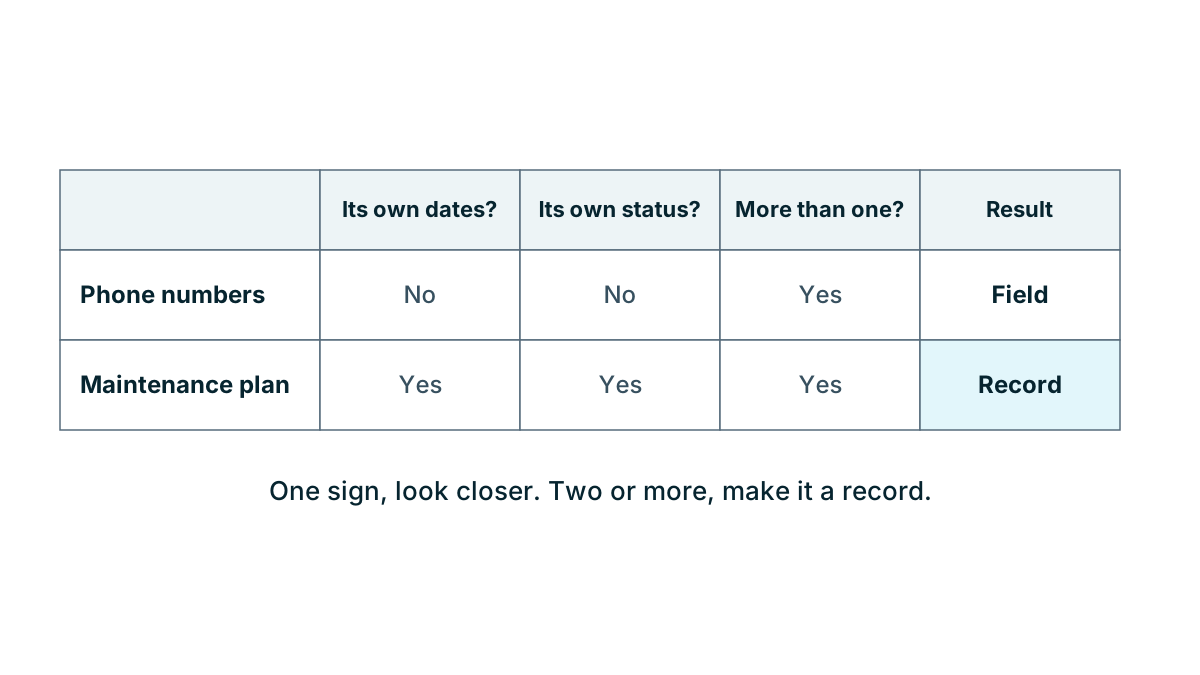
The most common miss is a date or a status sitting on the wrong record. Watch for these three.
- A Contract end date field on the company. It works until the first renewal, when you type over the old date and lose the history. The contract has its own dates, so it needs its own record.
- A Job status field on the contact. It works for a customer with one job. The day they book a second, the field can only describe one of them.
- A Last service date field. It tells you when you were last there, and nothing about the visit before, or whether one was missed.
Here's a quick test you can run on any existing spreadsheet: if a column gets typed over every time something happens, that something is probably a record.
How do you record work that repeats?
Repeat work trips up a lot of people, so it's worth slowing down. A customer on a yearly maintenance plan gets two visits a year. It's tempting to make one record and update it after each visit. Don't. There are two different things here.
- The plan is the promise. It has a start date, a renewal date, a price and a status.
- The visit is the work. It has its own date, who went, what they found and whether it happened at all.
The plan is the parent and the visits are its children. Now the questions that matter have answers. Which visits were missed last month? Which plans renew in June? How many visits do we still owe this year?
The same pattern turns up all over the place: a subscription and its monthly charges, a season agreement and its weekly mows, a retainer and its monthly reports. Whenever work repeats, look for the promise and the occurrences, and give each one its own record.
Activities, people and places
Once you've listed your activities, you'll see that records fall into two groups.
People and places are the things that last: contacts, companies, sites and the equipment you look after. They change slowly. A customer is still a customer next year, and a building rarely has a status that changes every week.
Activity records are things that happen: quotes, jobs, visits, appointments, cases and orders. They start and they finish. They nearly always have a date and a status. They are also what your reports count, because most reports are a count of activities over a period: jobs done in March, quotes won this quarter, visits missed this month.
Activity records hang off people and places. A job belongs to the customer who pays and happens at a site. A visit belongs to a plan and happens at a property. When you draw your map, put people and places along the top and activities underneath, and check that each activity links to whoever pays for it and, where it matters, to the place where the work happens.
If your map is mostly people and places with very few activity records, look again. Activity facts are probably squeezed into fields somewhere.
A worked example
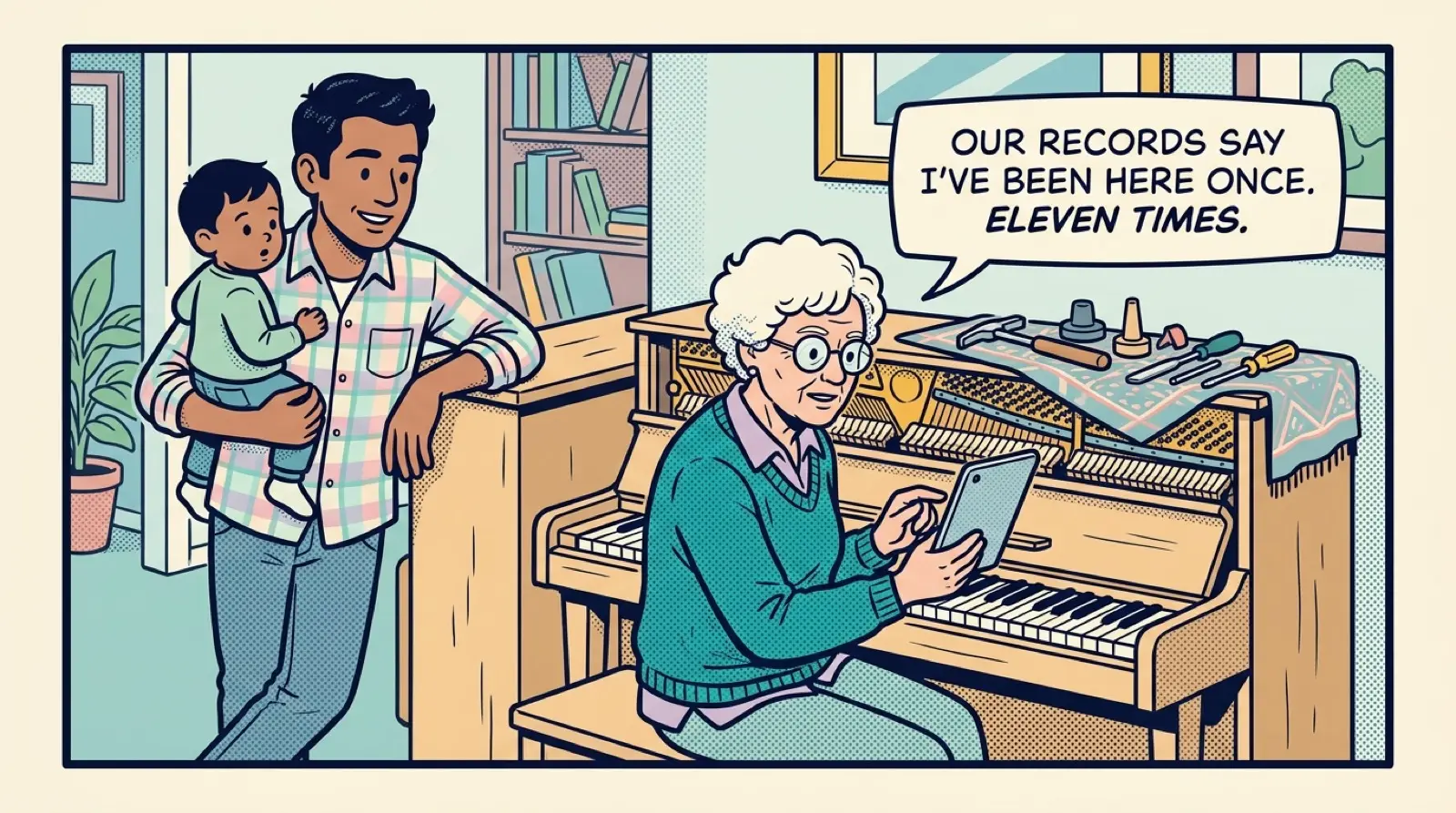
Here is an invented example. A piano tuning business has two tuners and a few hundred customers, from families with one upright to a school with fourteen pianos. Its work is tuning visits every six or twelve months, quotes for repairs, and bookings taken by phone. The old spreadsheet had one row per customer, with a Last tuned column that was typed over after every visit.
Planned from the work, it looks like this:
- Customer, a contact, because people pay.
- Piano, because one customer can own several, each with its own age, condition and history. It's the thing the work is done on, so it sits with people and places.
- Tuning plan, the promise of a visit every six or twelve months, with a renewal date.
- Visit, one per tuning, with its date, the tuner and what they found.
- Quote, for repairs, with its own status.
That's five records. Bookings don't need a sixth, because each booking is the visit with a date in the future. Now the owner can see how a piano's condition has changed over several visits, which pianos are overdue, and which repair quotes are still waiting for an answer.
Tip
Name records in the words your team already uses. If everyone says tuning, don't call it a service visit because that's what the CRM calls it. Most products let you rename record types, and the right name saves a little confusion every day.
- List what your business does each week, as verbs.
- Write the record each one needs, and cross out work you don't really do.
- Check each record against the three signs: own dates, own status, more than one.
- Find columns that get typed over, and ask whether each one hides a record.
- Sort your records into people and places, and activities, and link each activity to whoever pays.
Key takeaways
- Plan from what your business does, not from a list of nouns. Activities are where the money and the reports are.
- Something needs its own record when it has its own dates, its own status, or there can be more than one. Two signs settle it.
- Repeat work is two records: the plan that promises it and the visits that deliver it.
- People and places last. Activity records start and finish, and they hang off the people and places they belong to.
Common questions
Should I plan a CRM from a list of nouns?
It is better to start from the verbs. Nouns such as customers and products cover the people and places, but they miss the work that earns the money. Write down what happens in a normal month first.
How do I know if something should be a field instead of a record?
Check whether it has its own dates, its own status, or whether there can be more than one. Two signs make it a record. One sign is worth a closer look, and a customer's phone numbers stay as fields on the contact.
Should a yearly service plan be one record that I update after each visit?
No. The plan is the promise, with its own start date, renewal date, price and status. Each visit is the work, with its own date, the person who went and what they found, so keep them as parent and child records.
Keep your place and test yourself
Enroll for free to save your progress, take the chapter quiz, and get a certificate when you pass every chapter. The lessons stay open to everyone either way.