

Handing a Won Deal to the People Who Do the Work
The sale is won, and now someone else has to deliver what was promised. A one-page handover and ten minutes of talking keep the promises from getting lost.
Lesson 6 of 6 · 6 min read ·
Picture this invented job. A salesperson at a kitchen fitting firm spends three weeks with a couple. She learns that the old floor is uneven, that the street is too narrow for a large truck, that the husband works nights and sleeps until two, and that they need the kitchen done before a family visit in June. She wins the deal and moves on to the next one.
The fitter gets an address and a start date.
On Monday at 8 a.m., a truck that can't get down the street reverses and beeps outside the bedroom of a man who got to bed at seven. The customer's first impression of your delivery team is that nobody listened. In a sense, nobody did. The business knew everything it needed to know. It just knew it in the wrong head.
What is a handover?
A handover moves everything from the people who sold the job to the people who will do it. It should happen every time and in the same way, and it should happen before the customer is contacted about the work.
It's easy to skip, for an honest reason. The salesperson wants to get on with selling, the crew are busy, and it feels like paperwork. So make it short.
What should a one-page handover include?
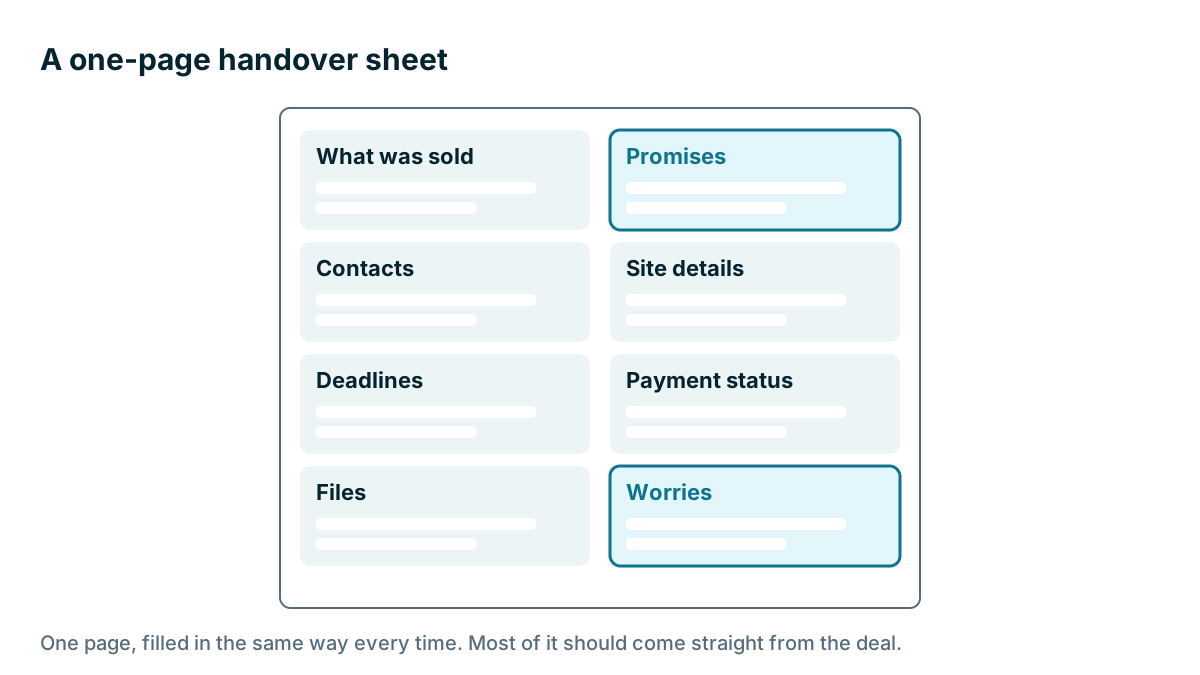
Each of the items below belongs on the handover. Most of it should already be on the deal, which is a good reason to record things as you go.
- What was sold, with a link to the signed quote or contract
- Exactly what's included and excluded
- Anything promised in conversation that isn't in the quote
- The main contact, the best way to reach them and the best time
- Who else has a say, such as a landlord or a spouse
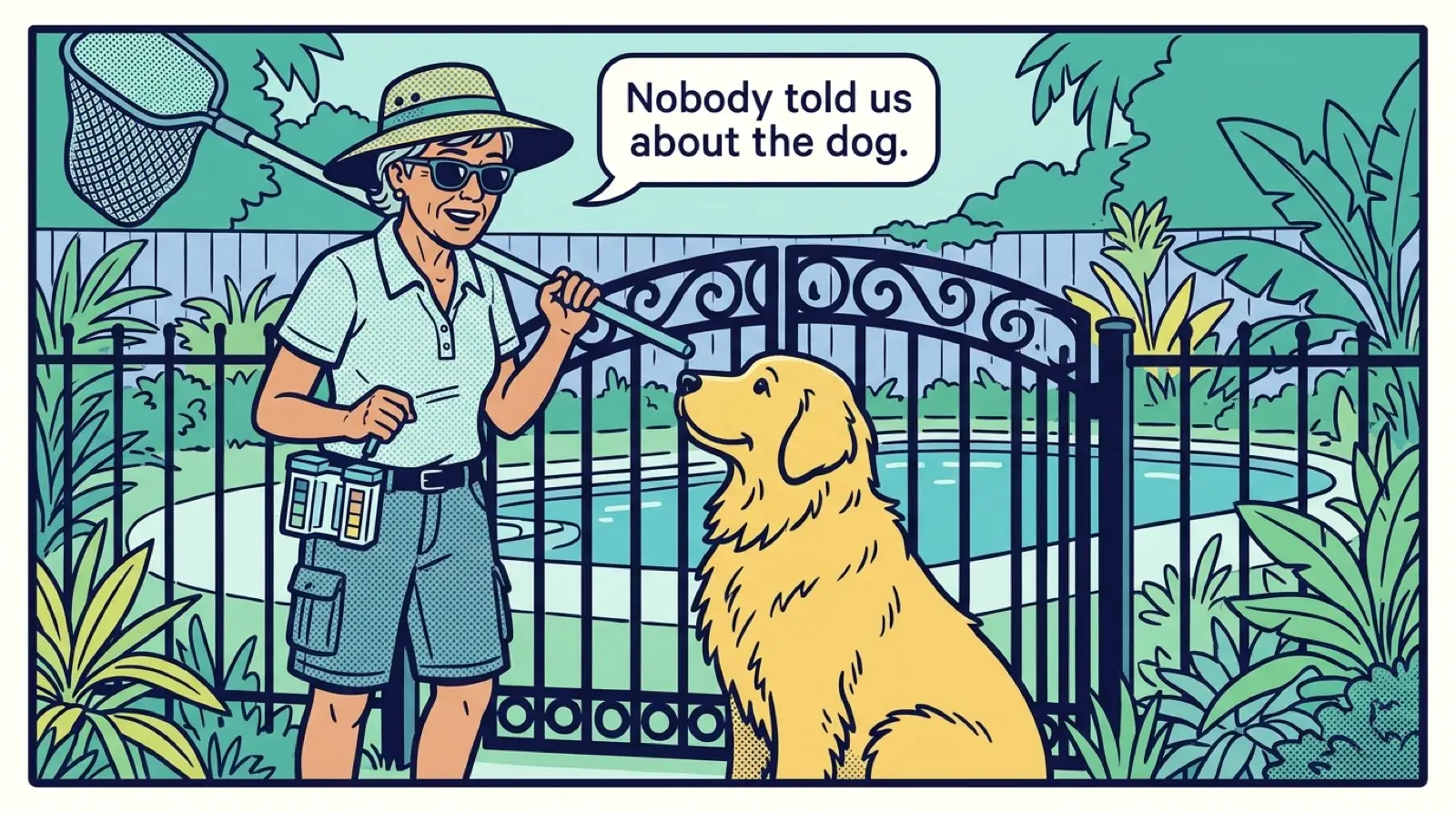
- Site details: access, parking, pets, alarms, hours
- Deadlines, and why they matter
- Payment status: deposit received, next invoice stage
- Files: drawings, photos, measurements, specifications
- Worries: anything the salesperson thinks might go wrong
Two of these are worth more than the rest. Anything promised in conversation is a common source of trouble, because no document has it. Worries is the one salespeople will only fill in if you ask, and it's often the most useful line on the page.
Make the handover a gate
Treat the handover as a step in your process, with a clear rule: a job isn't handed over until the page is complete and the person doing the work has accepted it.
Here is how an invented HVAC firm runs it:
- A deal moves to Won. The contract is signed and the deposit invoice is out.
- A task appears for the salesperson: complete the handover within one working day.
- The office manager checks that it is complete and books a ten-minute talk.
- The salesperson and the lead installer go through it together, on the phone or in person.
- The installer asks questions and accepts the job.
- Only then does the office call the customer to book a start date.
Those ten minutes matter. A form tells the installer what the salesperson thought to write down. A talk brings out what they didn't. The installer will look at the drawing and ask where the condenser is going to go, and the salesperson will remember something.
Tip
If the salesperson promises something outside the quote, the fix belongs at the moment of the promise. Agree a rule: if it isn't written on the deal, the crew won't do it. It sounds harsh for a day or two. Then people start writing things down.
Where should the work live after the sale?
Once a job is won, it needs a home. There are three common setups.
| Setup | Good for | Watch out for |
|---|---|---|
| Keep it in the CRM with a second pipeline, such as Scheduled, In Progress, Complete | Simple jobs, small teams | Delivery details can get squeezed into fields not built for them |
| A separate job or project tool | Scheduling crews, complex jobs | Two records of one job, so details need copying or a connector |
| A shared board or spreadsheet | Low volume, one crew | Nobody updates it unless someone owns it |
None of these is the right answer for everyone. A delivery pipeline is often a good place to start, because the history stays on one record and sales can see how the job is going. If you outgrow it, a job management tool can take over, and a connector can carry the details across.
Whichever you pick, a salesperson should be able to answer the customer's question, how is my job going, in under a minute. If they have to call the crew to find out, your handover only runs one way.
What should come back to sales after a job?
The handover has a return trip, and most businesses miss it. When the job is finished, three things should flow back to the sales side.
The result. Did the job match the quote? As we saw in the margins lesson, comparing quoted hours with real hours shows you what you underprice.
The customer's reaction. Was the customer happy? If so, this is the moment to ask for a review or a referral, while the good feeling is fresh. If not, you want to know before they tell anyone else.
The next date. Most trades have a natural next sale, such as a service visit, a repaint, a renewal or an annual check. Create a task or a follow-up deal now, dated for when it's due. A furnace installed this year needs a tune-up next year, and the customer won't remember who to call unless you do.
An invented sign shop might have 80 jobs a year. If only ten of those customers come back in the next year because somebody remembered to call them, that is ten warm conversations it didn't have to pay to find.
What this chapter built
Look at what this chapter has built: a deal, a quote, a price, a margin, a signature, an invoice and a handover. In a small business, one person often does every step and carries the rest in their head. That works until you hire someone, take a holiday or get busy. Each lesson here gives you one less thing to remember, whether you do it with a CRM, a template or a sheet of paper.
Key takeaways
- A handover moves what the seller knows to the people doing the work, before anyone contacts the customer about the job.
- Use one page, and always include verbal promises and the salesperson's worries.
- Add a ten-minute talk. It brings out what nobody thought to write down.
- Close the loop when the job ends: compare results, ask for a review and date the next contact.
Common questions
How do I hand a sold job to the installers?
Use a one-page handover that covers what was sold, exclusions, promises, contacts, site details, deadlines, payment status, files and worries. Then have the salesperson and lead installer go through it together for ten minutes, before the start date is booked.
What do documents usually miss in a handover?
Promises made in conversation, because no document has them. The salesperson's worries are also worth asking for, since they are often the most useful line on the page.
What if a salesperson promises something outside the quote?
Agree a rule at the moment of the promise: if it isn't written on the deal, the crew won't do it. That can sound harsh for a day or two, but people start writing things down.
Keep your place and test yourself
Enroll for free to save your progress, take the chapter quiz, and get a certificate when you pass every chapter. The lessons stay open to everyone either way.