

From Deal to Quote
A quote is a written promise. Here is what to find out before you write one, what belongs on it, and how to keep it tied to the deal.
Lesson 1 of 6 · 6 min read ·
So far in this course a deal has been a card on a board. This chapter follows that card until it turns into money in the bank and a finished job. The first step is the quote, and it matters more than it looks.
A quote is the first time the customer sees your business in writing. It sets the price, and it also sets what they think they are getting. Most arguments at the end of a job start with something vague at the start of it.
Find out four things first
A fast quote is good. A fast quote for the wrong job is expensive. Before you write anything, make sure the deal record answers these questions:
- What exactly does the customer want done, in their words?
- Who decides, and who else needs to agree?
- When do they need it, and what happens if it's late?
- What have they said about budget, even roughly?
If you can't answer one of these, a short call will usually cost less than a wrong quote. Put the answers on the deal, not in your head. If you are on holiday when the customer calls back, someone else should be able to pick it up.
What belongs on a quote?
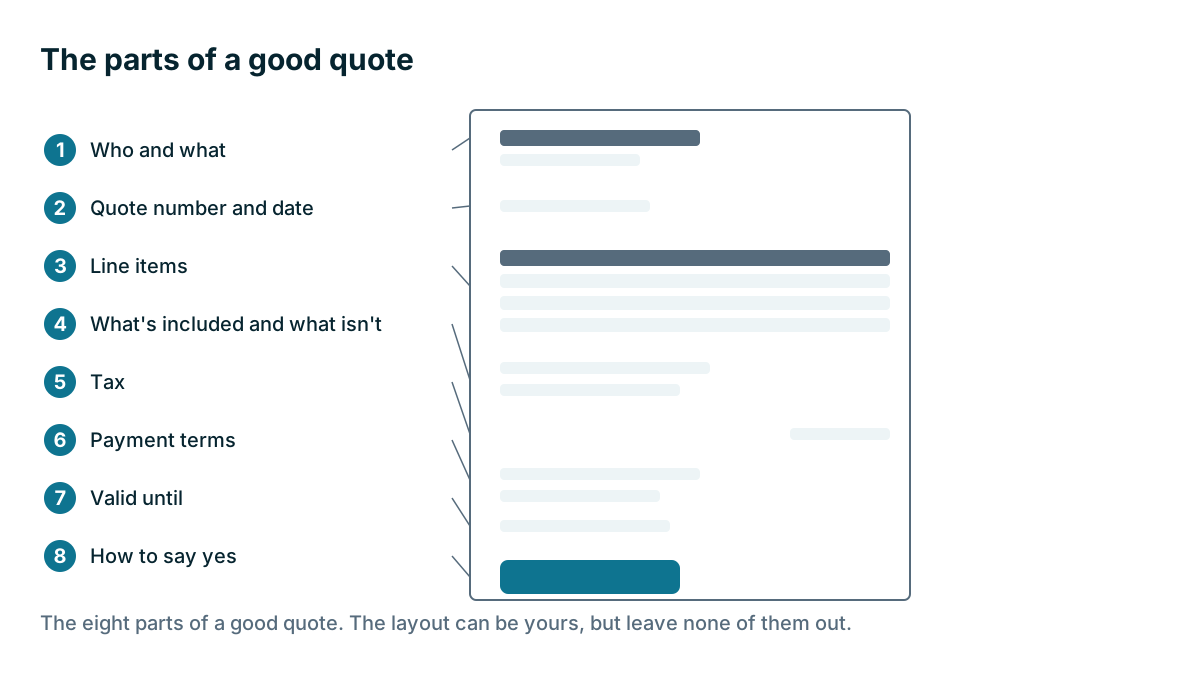
Whether you use a quote builder, a word processor or a template in your invoicing software, a good quote has the same parts.
- Who and what: customer name, contact, job address and a short title for the job.
- A quote number and date: so that everyone can refer to the same version.
- Line items: each thing you are charging for, with quantity, unit price and line total.
- What's included and what isn't: this is the part most people skip.
- Tax: shown as its own line. Check the rules for your location and your trade with your accountant.
- Payment terms: deposit, stages and when the balance is due.
- Valid until: the date after which the price may change.
- How to say yes: one clear next step, such as sign here or reply to this email.
A worked example
Here is an invented sign shop quoting a lit sign for an invented dental office. The numbers are made up to show the method.
| Line | Quantity | Unit price | Line total |
|---|---|---|---|
| Lit wall sign, 8 feet wide | 1 | $4,200 | $4,200 |
| Mounting hardware | 1 | $380 | $380 |
| Installation labor, hours | 8 | $95 | $760 |
| Permit handling | 1 | $260 | $260 |
| Subtotal | $5,600 | ||
| Sales tax at an invented 8% | $448 | ||
| Total | $6,048 |
The terms say 50% deposit on signing, which is $3,024, and the balance of $3,024 on installation. The quote is valid for 30 days. Under the lines, it says what is included (design, one round of changes, removal of the old sign) and what isn't (electrical work to bring power to the wall).
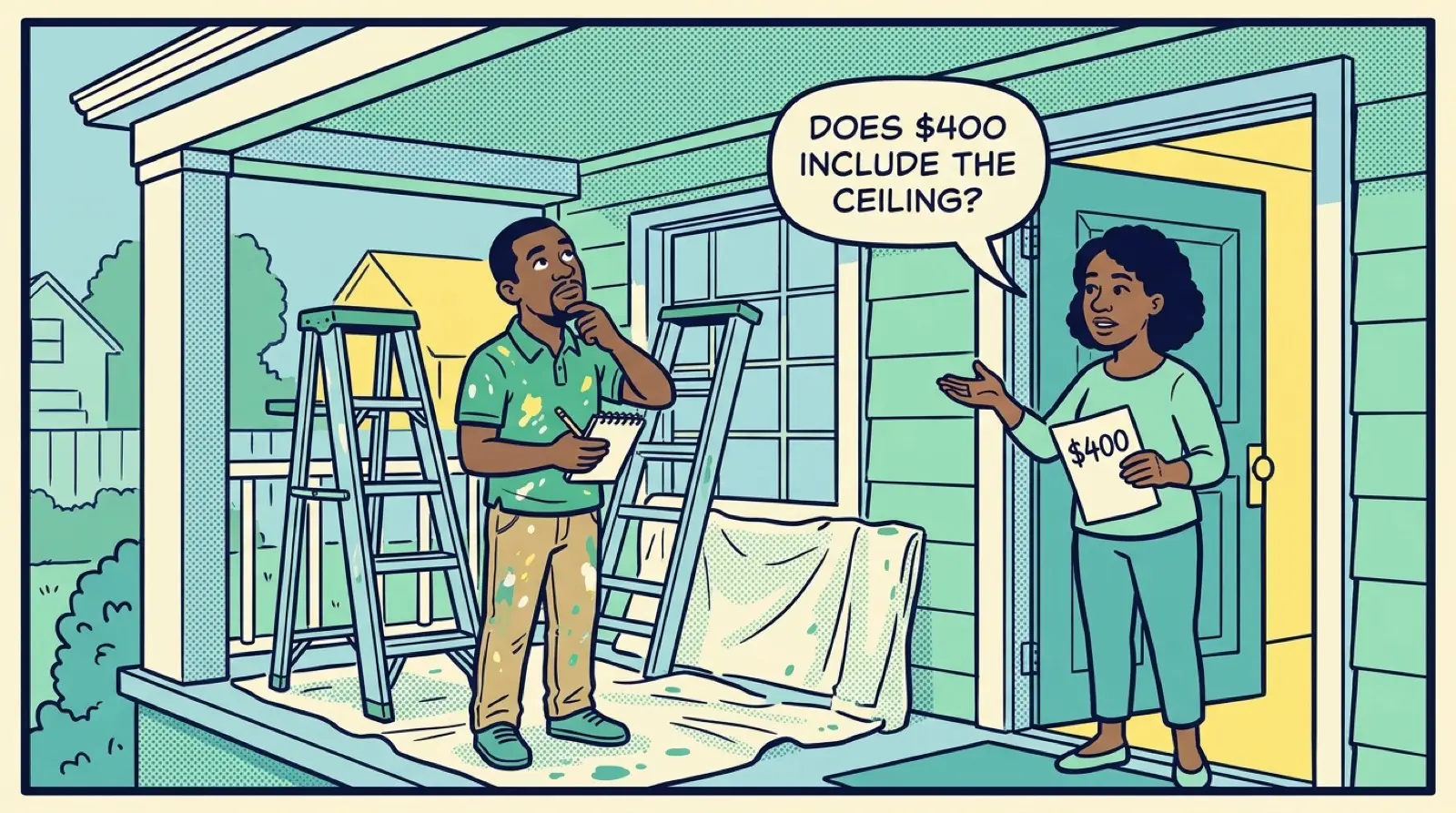
That last sentence earns its keep. Without it, the owner of the dental office may assume that power is part of the job, and the sign shop finds out on installation day, standing on a ladder.
How do you tie the quote to the deal?
Wherever you build the quote, keep four connections between the quote and the deal:
The amount. The deal value should match the quote. Decide once whether deal values are before tax or after, and stick to it. Before tax is usually better, because tax isn't your revenue. In the example, the deal value is $5,600. Mixed habits here will make your reports wrong in ways that are hard to find later.
The stage. Move the deal to your quoted stage on the day the quote goes out, not when you start writing it. Then Quoted means the customer has it.
The date. Set a follow-up task when you send. A quote with no follow-up date is a quote you are hoping about. Pick a number of days that suits your trade and use it every time.
The file. Keep the sent version on the deal. If you build quotes in a separate tool, attach the PDF. When the customer calls, you want to see exactly what they are looking at.
Tip
Never edit a quote the customer already has. Copy it, make the changes and send it as version 2, with a new date. If you overwrite version 1, you lose the record of what was offered, and sooner or later someone will ask.
What if the customer asks for options?
Customers often ask for options. A good way to handle that is one quote with optional lines, or a version A and version B on the same deal, with one marked as current. Avoid creating a second deal for the same job. Two deals for one job means your pipeline shows the money twice.
If you are a small business, you don't need a quote builder to do any of this. A clean template and a saved PDF will do the job for a few quotes a week. The time to look for a built-in quote tool is when you are retyping the same lines, when prices differ between staff, or when you can't tell which version the customer has. Add it to your must-haves only if one of those is true.
How fast should you send a quote?
There is no prize for a perfect quote that arrives after the customer has picked someone else. Agree a target, such as next working day for simple jobs and three days for anything that needs a site visit, and treat it as a promise to yourself. If a job needs longer, tell the customer when to expect it. Silence reads as lack of interest.
Key takeaways
- Before quoting, know the job, the decision maker, the deadline and a rough budget, and record them on the deal.
- Every quote needs line items, inclusions and exclusions, tax, payment terms, a valid-until date and one clear next step.
- Write down what is not included. It prevents more arguments than anything else on the page.
- Keep the deal value, stage, follow-up date and sent file tied together, and never edit a quote the customer already has.
Common questions
Is a quote builder necessary for a small business?
No. A clean template and a saved PDF will do the job for a few quotes a week. Look for a built-in quote tool when you keep retyping the same lines, prices differ between staff, or you cannot tell which version the customer has.
Can I change a quote after the customer has seen it?
Not in place. Copy it, make the changes and send it as version 2 with a new date. If you overwrite version 1, you lose the record of what was offered.
Should deal values include tax?
Before tax is usually better, because tax isn't your revenue. Decide once and stick to it, because mixed habits make your reports wrong in ways that are hard to find.
Keep your place and test yourself
Enroll for free to save your progress, take the chapter quiz, and get a certificate when you pass every chapter. The lessons stay open to everyone either way.