

Products, Price Lists and Discounts
A short product list stops people making up prices. Here is how to build one, when you need more than one price list, and what a discount really costs.
Lesson 2 of 6 · 7 min read ·
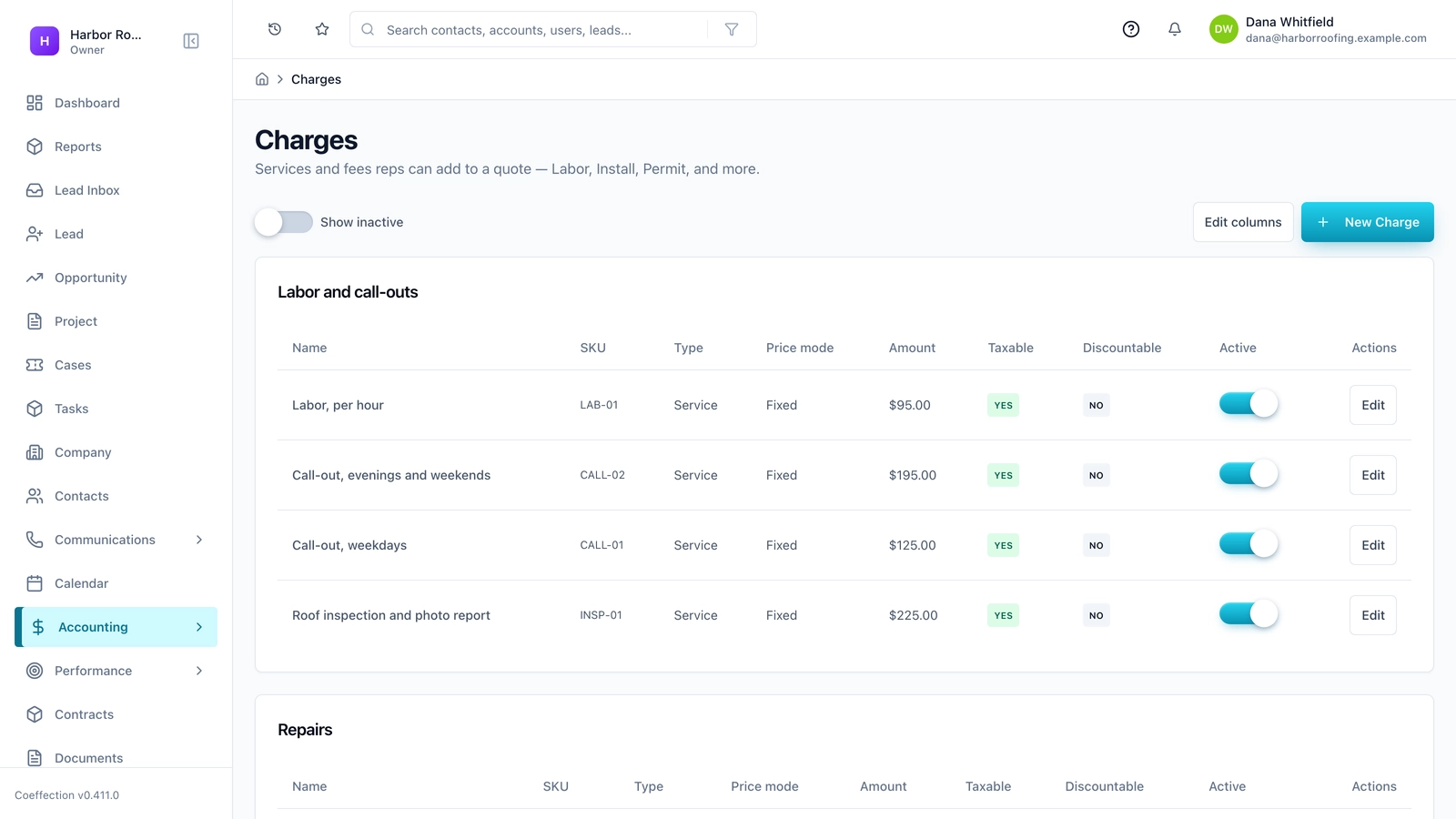
If two people in your business would quote the same job at different prices, you have a pricing problem, and it's probably not about the prices. It's that the prices live in people's heads.
The fix is a product list, also called a catalog or a price book. It sounds like a thing for manufacturers. It works just as well for a service business.
How do you build a short product list?
A product list is every standard thing you sell, written down once. In a service firm, a product can be an hour of labor, a call-out, a monthly plan or a fixed-price job.
Each item needs only a few fields:
- Name: the words the customer will see on the quote.
- Description: what it includes, in a sentence.
- Unit: each, hour, visit, square foot or month.
- Cost: what it costs you. This one stays private.
- Price: what you normally charge.
- Tax setting: whether tax applies. Ask your accountant.
Don't try to list everything. Go through your last 20 quotes and pull out the lines that keep coming back. A short list that people use beats a thousand items that nobody can search. Keep one catch-all item for one-off work, and look at what lands in it every few months. If something shows up often, it has earned its own line.
When is one price list not enough?
Many small businesses need one price for everyone, and they should stop there. You need more than one price list when different groups of customers really do pay different prices.
Here is an invented HVAC firm with two lists. All the figures are made up.
| Item | Unit | Cost | Standard price | Service plan price |
|---|---|---|---|---|
| Furnace tune-up | Visit | $45 | $149 | $119 |
| Call-out, weekdays | Visit | $60 | $125 | $95 |
| Labor | Hour | $48 | $120 | $105 |
| Thermostat, fitted | Each | $110 | $260 | $260 |
Service plan customers pay less on most lines, and the plan gives them a reason to stay. Now a technician picks the customer's list and the right prices appear. Nobody has to remember the rule.
Two features are worth checking if price lists matter to you:
Effective dates. When your prices go up on the first of March, you want the new prices to start that day without changing quotes you already sent. Ask each CRM how that works.
Stored prices on the quote. Once a quote is sent, the prices on it should stay put, even when the product list changes later. Test this in your trial: send a quote, change the price of a product, and open the quote again.
If your CRM doesn't handle price lists, a spreadsheet kept by one person, with a date on it, is a fair stand-in for a small firm. The point is that there is one list and everyone knows which one it is.
What a discount really costs
A discount feels small because it comes off the price. It hurts because it comes straight out of the profit.
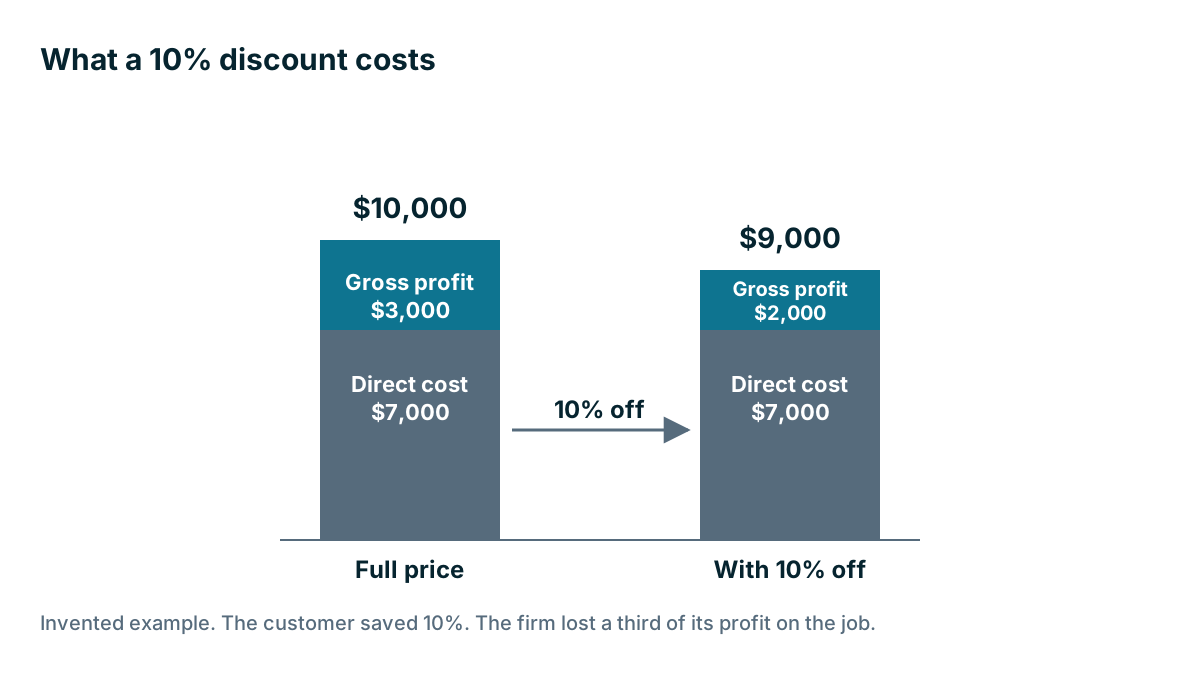
Stay with the invented HVAC firm. A system replacement is priced at $10,000 and costs the firm $7,000 to deliver, leaving $3,000 of gross profit, which is what's left after the direct cost of the job. A salesperson takes 10% off to close the deal.
| Line | Full price | With 10% off |
|---|---|---|
| Price | $10,000 | $9,000 |
| Direct cost | $7,000 | $7,000 |
| Gross profit | $3,000 | $2,000 |
The customer saved 10%. The firm lost a third of its profit on the job. To make the same $3,000 at the lower price, it would need to do one and a half jobs instead of one.
That doesn't mean you should never discount. It means a discount should buy you something.
What simple discount rules should you set?
Write the rules down, even if you are only three people:
- Who can give what. For example, anyone can give up to 5%, and more needs the owner.
- Why it was given. Pick from a short list, such as repeat customer, competing quote or quiet season. A reason field costs nothing, and after six months it shows you what's going on.
- What you get back. Ask for something in return: a deposit up front, a larger order, a flexible start date or a review.
- Line or total. Decide where discounts go. A discount on the total hides which item lost its profit, so many firms discount individual lines.
Before cutting the price, try adding value instead. Our HVAC firm could include a free first tune-up. That costs it $45 and the customer sees it as worth $149. Compare that with a $1,000 discount.
Watch out
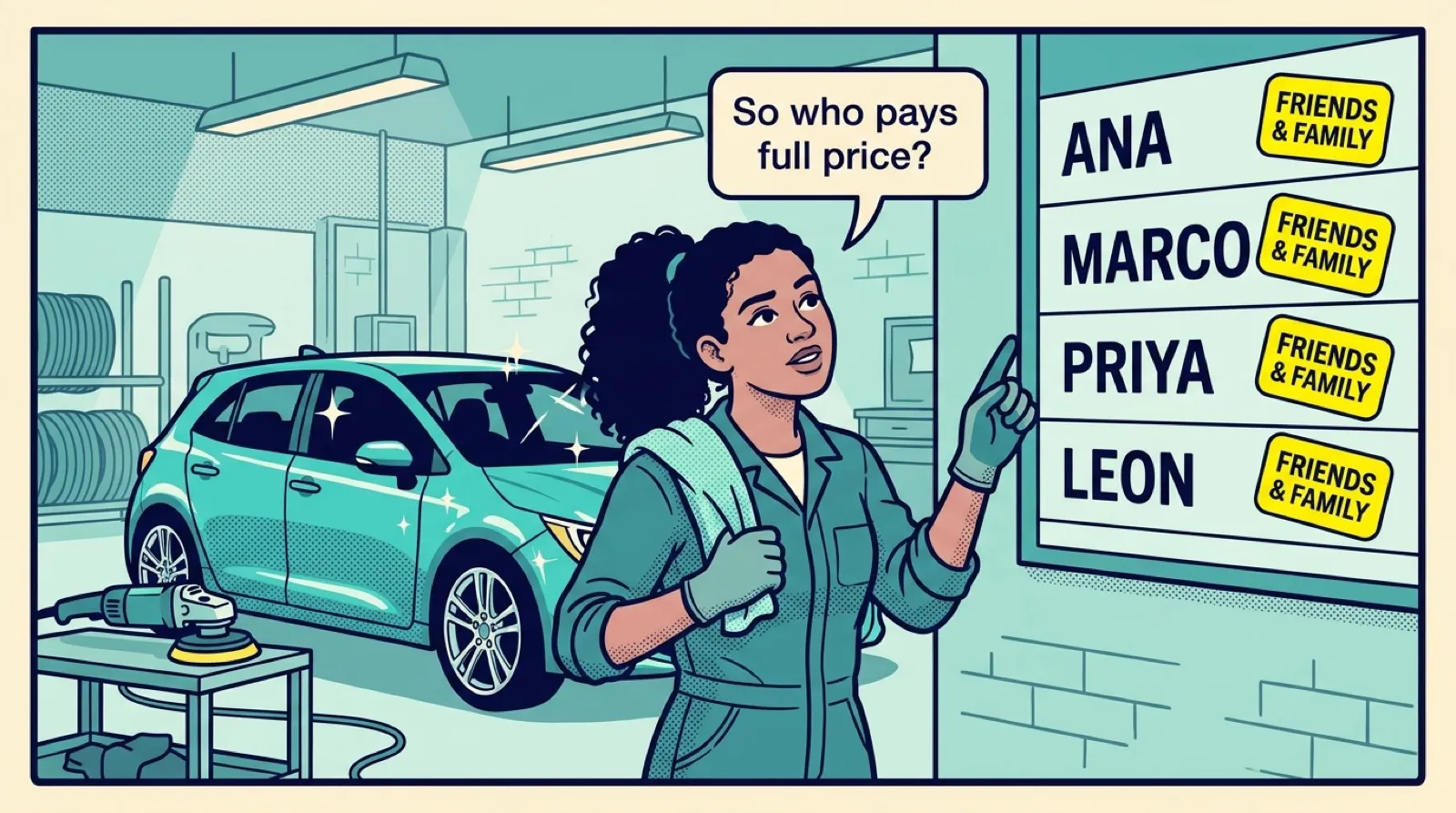
Watch out for the same customer asking two people. If one salesperson says no and another says yes, your customers will learn who to call. Keep the reason on the deal, and let your rules give the answer rather than the mood of whoever picks up the phone.
An afternoon's work
If you do nothing else in this chapter, do this. It needs no software.
- Pull your last 20 quotes and list the lines that repeat
- Write down the cost and the normal price of each one
- Put the list where everyone quotes from
- Agree who can discount, how much, and why
- Set a date to check prices, at least once a year
Key takeaways
- A product list stops people making up prices. Start with the lines that repeat in your last 20 quotes.
- You need more than one price list only when different groups of customers truly pay different prices.
- Check that price changes can start on a set date, and that sent quotes keep their prices.
- A 10% discount can remove a third of the profit on a job, so make each one buy you something.
Common questions
How many items should a product list have?
Keep it short. Start with the lines that keep coming back in your last 20 quotes, and keep one catch-all item for one-off work. If something shows up often, it has earned its own line.
How much does a 10% discount cut into profit?
In the invented example in this lesson, a 10% discount on a $10,000 job that costs $7,000 cuts gross profit from $3,000 to $2,000. That is a third of the profit gone.
Should a product list show my costs?
Each item can record your cost, and that field stays private.
Keep your place and test yourself
Enroll for free to save your progress, take the chapter quiz, and get a certificate when you pass every chapter. The lessons stay open to everyone either way.