

Margins and Approvals
Margin and markup are not the same number, and mixing them up costs real money. Here is how to work out margin, set a floor, and approve exceptions without slowing down.
Lesson 3 of 6 · 7 min read ·
Plenty of good businesses stay short of cash because they sell a lot of work at a price that doesn't leave enough over. Often nobody noticed. The total looked fine, the customer was happy and the crew was busy.
This lesson covers two things that catch this early: knowing the margin on a job before you send the quote, and having someone check the ones that fall too low.
What is the difference between margin and markup?
Margin and markup are often used as if they mean the same thing, and they don't.
- Markup is profit as a share of your cost.
- Margin is profit as a share of the price.
Say a job costs you $7,000 and you sell it for $10,000. The profit is $3,000.
| Measure | Sum | Result |
|---|---|---|
| Markup | $3,000 divided by $7,000 | 42.9% |
| Margin | $3,000 divided by $10,000 | 30% |
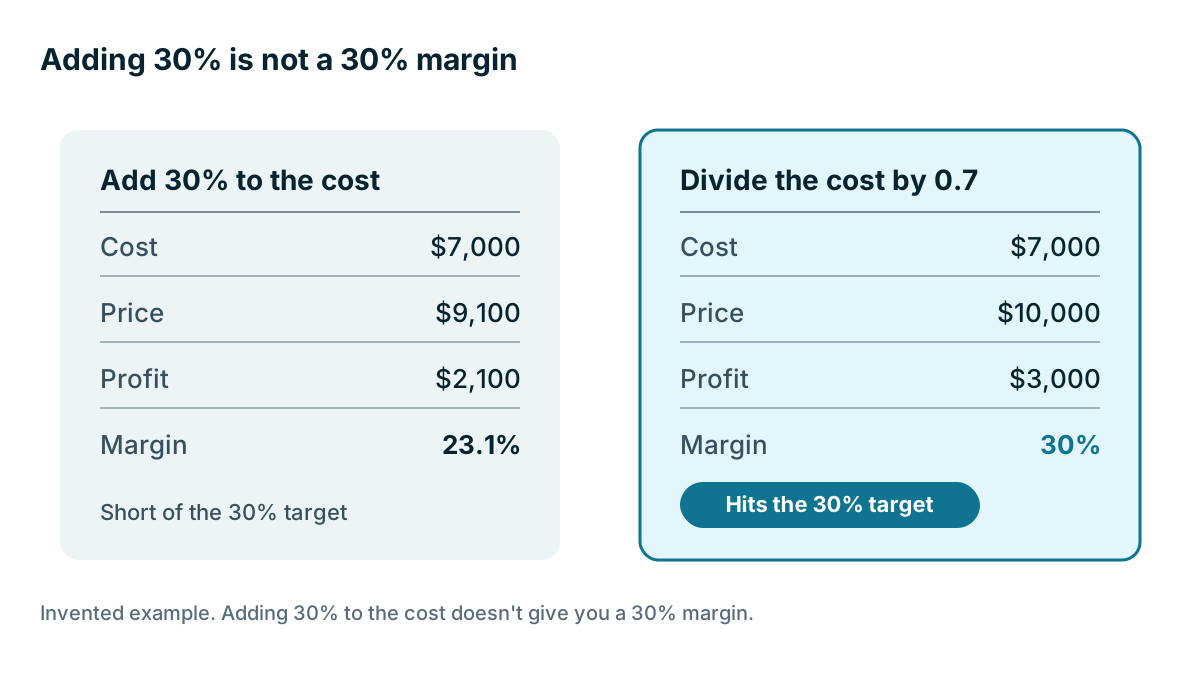
Same job, same money, two different percentages. The trap looks like this. An owner wants a 30% margin, so she adds 30% to her cost. A $7,000 job goes out at $9,100. The profit is $2,100, and $2,100 divided by $9,100 is a 23.1% margin. She is about seven points short, on every job, and she thinks she's on target.
To hit a target margin, divide the cost by one minus the margin. For 30%, that is $7,000 divided by 0.7, which gives $10,000.
Count every direct cost
Margin is only as good as your cost figure. In this lesson, cost means what the job itself consumes. Here is an invented landscaper pricing a patio and planting job. All the numbers are made up.
| Direct cost | Sum | Amount |
|---|---|---|
| Materials and plants | From supplier quotes | $8,400 |
| Crew labor | 120 hours at $35 | $4,200 |
| Machine hire | 3 days at $300 | $900 |
| Waste disposal | Fixed fee | $500 |
| Total cost | $14,000 |
The landscaper prices the job at $20,000. Gross profit is $6,000, and the margin is 30%.
The items people forget are labor at its true cost (including payroll taxes and travel time), subcontractors, delivery and disposal. If you only count materials, every margin in your business will look better than it is.
Gross margin also has to pay for everything that isn't a job: the office, the vans, insurance and you. Work out with your accountant what margin you need overall. We won't give you a target, because the right number varies a lot by trade.
What is a margin floor?
A floor is the lowest margin you will accept without someone looking at it. Say our landscaper sets a floor of 25%.
A salesperson wants to take 8% off the $20,000 job to win it.
| Line | At list price | With 8% off |
|---|---|---|
| Price | $20,000 | $18,400 |
| Cost | $14,000 | $14,000 |
| Gross profit | $6,000 | $4,400 |
| Margin | 30% | 23.9% |
That falls below the floor, so it needs a yes from someone. Working backward, $14,000 divided by 0.75 is about $18,667. So the salesperson can go down to about that price, a discount of about 6.7%, without asking.
A rule like this has a useful side effect. It gives the salesperson a real reason to hold the price, and a clear limit on what they can offer.
How do you keep approvals from slowing the deal?
An approval is a second person saying yes before something goes to a customer. Used well, it takes minutes. Used badly, it becomes the reason you lose the deal.
Here is a simple rule set for a small firm:
| Situation | Who says yes |
|---|---|
| Margin at or above the floor | Nobody. Send it. |
| Margin below the floor | Owner or sales manager |
| Any job above a size you choose | Owner, once, before it goes out |
| Non-standard payment terms | Owner |
Make it easy to answer. The person asking should send the job, the price, the margin, the reason and the deadline in one short message. Agree a response time, such as the same working day. If the approver is out, name a backup. If you have nobody to approve because you are a solo owner, set the floor anyway and make yourself sleep on anything below it.
Keep the answer with the deal. A note saying who approved it and why is enough. Six months later, when you ask why that job made so little, the answer is there.

Tip
Some CRMs can show margin as you build a quote and stop a quote below your floor until someone approves it. That can be worth paying for once several people quote. If only one or two people quote, a shared rule and a calculator work well. Test the feature with a real job before it goes on your must-have list.
Keep cost out of the wrong places
Your costs are sensitive. A customer who sees them will argue with them, and a printed quote that shows margin is an awkward thing to send by mistake. Check two things in any CRM you use. First, can you control which roles see cost and margin? Second, when you export or print a quote, what appears on it? Send yourself a test quote and read it as a customer would.
Check the promise against the result
A quote's margin is a forecast. When the job finishes, compare it with what really happened, even if only for your biggest jobs. If the landscaper quoted 120 crew hours and used 150, the extra 30 hours at $35 cost $1,050, and the real gross profit was $4,950. That is a 24.8% margin instead of 30%.
Do that for ten jobs and you will know which kinds of work you underprice. That is worth more than any feature in this lesson.
Key takeaways
- Markup is profit over cost. Margin is profit over price. They are different numbers.
- To reach a target margin, divide cost by one minus the margin. Adding the percentage to cost falls short.
- Count every direct cost, then set a floor below which someone else has to look.
- Keep approvals fast: one message with the numbers, a same-day answer, a named backup and a note on the deal.
Common questions
Why does adding 30% to my cost not give a 30% margin?
Markup divides profit by cost, while margin divides it by price. To hit a 30% margin on a $7,000 cost, divide the cost by 0.7, which gives a $10,000 price.
What happens to margin when a salesperson gives a discount?
In the invented landscaping example, an 8% discount on a $20,000 job that costs $14,000 drops the margin from 30% to 23.9%, which is below a 25% floor.
Does an approval step have to delay a quote?
It doesn't have to. Send the job, price, margin, reason and deadline in one short message, agree a same-day answer and name a backup. A solo owner can set a floor and wait a night before approving anything below it.
Keep your place and test yourself
Enroll for free to save your progress, take the chapter quiz, and get a certificate when you pass every chapter. The lessons stay open to everyone either way.