

Chapter 4: Pipelines and Sales Funnels
More Than One Pipeline, and When Not To
A second pipeline is right when the work follows different steps. It's wrong when you only want to tell deals apart. A filter usually does that job for free.
Lesson 6 of 6 · 6 min read ·
Sooner or later, someone suggests a second pipeline. One for residential and one for commercial. One for each salesperson. One for each town. It sounds tidy, and once you have made one, the rest come easily. A year later you have nine boards, your reports don't add up, and nobody can find anything.
Sometimes a second pipeline is exactly right. The trick is knowing which situation you are in, and there's one test that settles most cases.
The test: are the steps different?
You need a second pipeline when the sale follows different steps. If the steps are the same, you need a field.
That's most of it. A pipeline describes a process. If two kinds of deal go through the same stages, then they share one process, and all you need is a way to tell them apart. A dropdown field does that, and you can filter the board by it.
| You want to separate | Same steps? | Use this |
|---|---|---|
| Residential and commercial, same process | Yes | A customer type field |
| Each salesperson's deals | Yes | The owner field, and a filter |
| Towns or territories | Yes | A region field |
| Small and large jobs | Yes | The deal value, or a size field |
| New repair jobs and yearly contract renewals | No | Two pipelines |
| Direct sales and partners who resell for you | No | Two pipelines |
Most requests for extra pipelines are really requests for a filter. Try that first. It costs nothing and can be undone in a moment.
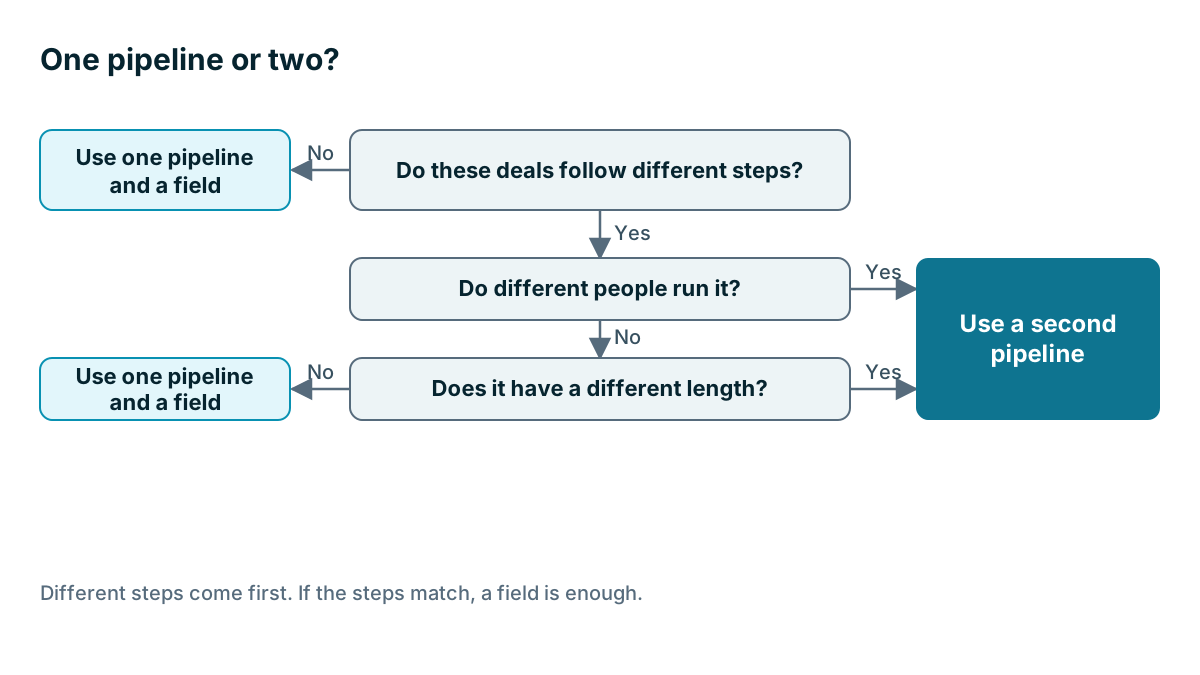
When does a second pipeline earn its place?
Look for two or more of these signs before you add a second pipeline.
- Different stages. The steps truly differ, not just their names.
- Different people. Another person or team runs that work from start to finish.
- A different length. One takes two days, and the other takes nine months.
- Different win rates. Mixing them would make your forecast meaningless, because a stage means something different in each.
Here is an invented example. A boatyard does two kinds of business. Repairs start with a call, then an inspection and a written estimate, and finish when the job is approved. Winter storage is a yearly renewal: a reminder goes out in August, the owner confirms, the deposit comes in, and the boat gets a slot.
These two share almost nothing. Repairs win or lose on the estimate. Storage is about getting the renewals in before the yard fills up. If they sat on one board, a Reminder sent stage would stand next to Inspection booked, and neither would make sense. Here, two pipelines are the right call.
The same yard might be tempted to add a third pipeline for engine repairs and a fourth for hull repairs. Those follow the same steps, so a Repair type field does the job.
What does a field and a filter look like in practice?
Say a window installer sells to homeowners and to builders, and wants them kept apart. The steps are the same, so he adds a Customer type dropdown to the deal, with two values. He then saves two filtered views of the same board and names them Homeowners and Builders. The person who handles builders opens that view each morning and sees only those deals.
He gets everything a separate pipeline would have given him, and he also gets one total for the business. If a builder deal turns into a homeowner deal, he changes one dropdown. Most CRMs can save a filtered view like this, so it's worth checking how yours does it.
What do extra pipelines cost you?
A new pipeline is quick to set up. The cost arrives later.
- Reports get harder. Total sales, win rates and forecasts now have to add up across boards, and the stages don't line up.
- People have to choose. Each new deal raises the question of which board it goes on. Some will pick the wrong one, and deals will fall between them.
- Moving a deal gets awkward. If a deal changes type, you may have to move it across, and you could lose its stage history.
- There is more to maintain. Every automation, stage rule and report has to be built and kept up for each one.
- It may cost more. Some plans limit pipelines, and we covered that in Chapter 2. Check before you plan around it.
Watch out
Be especially wary of one pipeline per person. It feels fair, and it makes every other job harder. Nobody can see the whole picture, and when someone leaves, their board goes with them. Use the owner field and let each person filter to their own deals.
Other things that aren't sales
A pipeline-style board can track any process with stages, and it's tempting to use one for everything. Onboarding a new customer, hiring, or tracking support tickets can all look like a row of columns.
For after-sale work, this can be genuinely useful. A second board for Onboarding, which starts when a deal is won, is common and sensible. It's a different process, run by different people, with a clear handoff.
But keep it out of your sales numbers. A job in delivery isn't a sale in progress. If your forecast adds it in, you will count that money twice. Check how your CRM keeps these apart, and whether a real project tool or your job management software would do it better. As we said in Chapter 1, a CRM isn't a project management tool, even if it can impersonate one for a while.
If you have outgrown one
Larger companies really can need several pipelines, with separate teams, branches and sales processes. Some CRMs are built with that in mind. Coeffection, for example, supports multi-stage pipelines that can differ by team or branch, with stage gates, and it is aimed at teams of roughly 20 to 200 people. Plenty of other products also handle several pipelines well. If you run a small team with one sales process, you won't need this, and paying for it would be a waste.
Before you add one, try this exercise. Write out the stages for the proposed pipeline next to your current stages. If more than half are the same, you probably have one process and a field. Then name the person who will own the new board. If you can't name one, don't build it.
How do you cut back on too many pipelines?
If you already have too many, you can merge them. Pick one main pipeline, write down what makes each old board different, and turn each difference into a field. Move your open deals across and leave closed deals where they are, so the history stays intact. Then hide or archive the old boards. Do this in a quiet week, and tell your team what changes before you start.
Key takeaways
- Use a second pipeline when the steps differ. If the steps are the same, use a field and a filter.
- Good signs are different people, a different length of sale and different win rates.
- Avoid one pipeline per person, per town or per deal size.
- A post-sale board can be useful, but keep it out of your sales numbers.
- Before adding a pipeline, compare the stages side by side and name an owner.
Common questions
How many sales pipelines does a small business need?
For a small team with one sales process, one pipeline is usually enough. Look for two or more signs, such as different stages, different people, a different length or different win rates, before you add a second.
Should each salesperson have their own pipeline?
No. It feels fair, but nobody can see the whole picture, and the board goes with the person when they leave. Use an owner field and let each person filter to their own deals.
Can I use a CRM pipeline for customer onboarding?
Yes, a second board for onboarding that starts when a deal is won is common and sensible. Keep it out of your sales numbers, because a job in delivery is not a sale in progress.
Keep your place and test yourself
Enroll for free to save your progress, take the chapter quiz, and get a certificate when you pass every chapter. The lessons stay open to everyone either way.