

Chapter 4: Pipelines and Sales Funnels
Designing Stages That Mean Something
A good stage is something that has happened, not how someone feels about a deal. Here is how to choose stages, write clear rules for each one, and spot a stuck deal.
Lesson 2 of 6 · 6 min read ·
Open a typical small business pipeline and you will find stages such as Warm, Hot, Following Up and Working On It. Most deals sit in the last two. The board looks busy and tells you very little, because those names describe a mood.
A good stage describes something that has happened. It should be a fact you could check.
Compare these two:
- Hot: the rep has a good feeling about this one.
- Site assessed: we have been to the property, and the photos and measurements are on the deal.
Two people can disagree about the first. They can't really disagree about the second. That matters, because every number you get out of your CRM rests on stages. If stages are feelings, your forecast is a pile of feelings with dollar signs on it.
What is an exit test for a stage?
For each stage, write one sentence that says what must be true before a deal can leave it. This is called the exit test, and it's the most useful thing in this lesson.
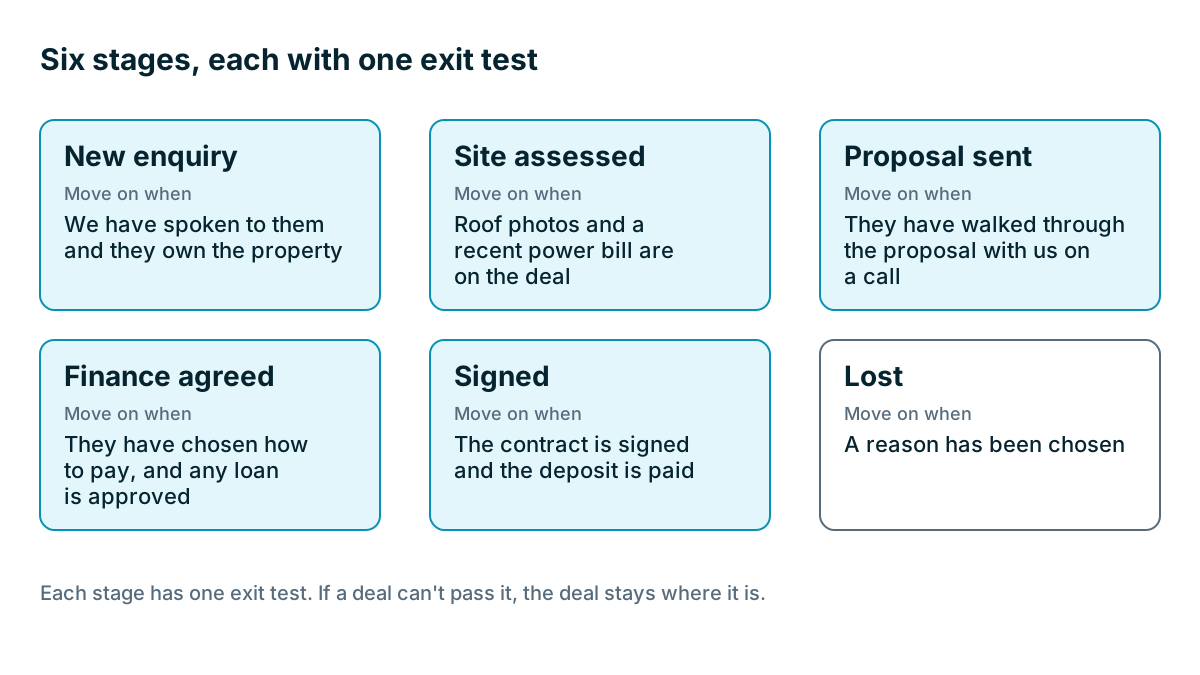
Here is an invented example. A solar installer starts with Lead, Hot, Following Up, Proposal, Almost There and Done. Everything drifts into Following Up. The owner sits down with the team and rewrites them.
| Stage | Exit test: move on when |
|---|---|
| New enquiry | We have spoken to them and they own the property |
| Site assessed | Roof photos and a recent power bill are on the deal |
| Proposal sent | They have walked through the proposal with us on a call |
| Finance agreed | They have chosen how to pay, and any loan is approved |
| Signed | The contract is signed and the deposit is paid |
| Lost | A reason has been chosen |
Look at Proposal sent. The test isn't that the proposal went out, because that would only prove the installer did something. The test is that the customer engaged with it. Whenever you can, tie your stages to something the customer did, because that is what predicts a sale. Sending a proposal is your action. Reading it and asking questions is theirs.
How many stages?
Most small businesses do well with four to seven open stages, plus Won and Lost. Fewer than four and everything looks the same. More than seven and people stop moving cards, because the difference between stages is too fine to care about.
A useful test for any stage is to ask what changes when a deal enters it. Does somebody do something different? Do the odds of winning shift noticeably? If neither, merge it with its neighbor.
Don't create a stage for every step in your process page from Chapter 2. A roofer's ten steps can become five stages, as we showed there. Steps are what you do. Stages are the points where the odds change.
Start with your last few sales
Don't design stages in the abstract. Take your last ten sales, both won and lost. Write down what happened in each one. You are looking for the moments that separated the real buyers from the rest.
You might find that everyone who came to the showroom bought, and nobody who only asked for a price by email did. Then Showroom visit deserves to be a stage. A bakery wholesaler may find that sending samples means little, but a tasting with the head chef is where deals are decided. So Tasting booked is a stage, and Sample sent is only a task.
How should you define Won and Lost?
Both Won and Lost need a clear meaning. Won means the customer has committed in the way you have agreed, such as a signature or a deposit. Decide which one, and write it down.
Lost needs a short list of reasons, chosen from a dropdown:
- Price
- Chose a competitor
- Timing, not this year
- No response
- Not a fit
Six months of this will teach you more than any report. If half your losses are No response, you have a follow-up problem. If most are Price, you might be talking to the wrong people, or failing to show your value.
Some businesses add a Parked or On Hold status for real deals on a long delay, such as a customer who wants to do the work next spring. Use it with a date to look again. Without a date, it turns into a cemetery that everyone can feel good about.
Stuck deals
A stage should also have a time limit. How long does a healthy deal usually stay in Proposal sent? Look at your own history. If most sales in that stage move within two weeks, any deal sitting there for six weeks is probably dying.
Decide your limit for each stage, then check it each week. Many CRMs can highlight old deals or show how many days a card has been in a stage. If yours can't, sort by last activity. Either way, a stale deal needs one of three things: a real next step, a move backward, or a Lost reason.
Tip
Put the exit tests where people will see them. Many CRMs have a description for each stage. Failing that, pin one page to the wall by the desk. Some products can go further and block a move until a required field is filled in. That's useful for a few key stages, but set it up after your team understands the rules, not instead of explaining them.
How do you agree stage rules as a team?
Whoever moves the cards should help write the tests. Run a thirty-minute meeting. Put five real deals on the screen and ask everyone which stage each is in. Where people disagree, the rule isn't clear yet, so rewrite it until they agree. Then try it for a month and adjust.
Changing a stage later isn't a disaster, but don't change it every week. Your history is only comparable if the stages hold still, so make changes rarely and write down the date.
Key takeaways
- A stage is a fact that has happened, not a feeling about a deal.
- Write one exit test for each stage, and tie it to something the customer did whenever you can.
- Four to seven open stages suit most small businesses. Merge any stage that doesn't change the odds or the action.
- Choose a short list of lost reasons, and set a time limit for each stage so stuck deals stand out.
- Agree the tests as a team by sorting real deals together.
Common questions
What is a pipeline stage exit test?
It is one sentence that says what must be true before a deal can leave a stage. Where you can, tie it to something the customer did, such as reading a proposal and asking questions.
How many stages should a small business pipeline have?
Most small businesses do well with four to seven open stages, plus Won and Lost. Merge any stage that does not change the odds or the action.
How long should a deal stay in one stage?
Set a time limit for each stage based on how long healthy deals usually take in your own history. A stale deal needs a real next step, a move backward or a Lost reason.
Keep your place and test yourself
Enroll for free to save your progress, take the chapter quiz, and get a certificate when you pass every chapter. The lessons stay open to everyone either way.