

Chapter 4: Pipelines and Sales Funnels
Lead Sources and Qualifying
Know where your good customers come from, and learn to spot a poor fit early. Saying no politely is one of the cheapest ways to win more work.
Lesson 3 of 6 · 6 min read ·
Not every enquiry deserves the same effort. Small business owners often treat every lead as precious, because each one feels like it could be the sale that saves the month. The result is hours spent quoting for people who were never going to buy, while good customers wait.
This lesson covers two habits that fix that. The first is recording where leads come from. The second is checking whether a lead is worth pursuing before you spend real time on it.
What counts as a lead?
A lead is someone who might buy but hasn't been checked yet. Whether a lead gets its own type of record depends on the CRM. Some keep leads separate and convert them into contacts and deals once they qualify. Others simply start everything as a contact with a deal at the first stage. Both can work. The first keeps your main list clean. The second has fewer steps and suits most small teams.
How do you track lead sources?
A lead source is how someone found you. It's one of the cheapest and most useful things you can record, and you can't fill it in later, because nobody will remember.
Set it up as a dropdown, with six to eight values. Use the channels you really have, such as Referral, Repeat customer, Website form, Google search, Directory listing, Social media, Trade show and Other.
Then ask every new lead, how did you hear about us? Web forms can have this as a field, and phone calls can have it as the first thing your team asks. Be aware that people's memory isn't perfect. Someone may say Google when a friend told them about you and they searched for your name. Treat your data as a useful guide, not as an exact measure.
After six months, count three things by source: leads, wins and revenue. Here is an invented example from a food truck that does private catering.
| Source | Leads | Won | Win rate | Revenue |
|---|---|---|---|---|
| Past customer referral | 12 | 6 | 50% | $18,000 |
| Website form | 40 | 5 | 13% | $10,000 |
| Event directory listing | 30 | 1 | 3% | $900 |
If the owner only counted leads, the directory would look like a good channel, with 30 enquiries. Counted by revenue, it's the weakest of the three, and each of those 29 lost leads took time to answer. Referrals bring in fewer leads but nearly double the revenue of the website form. So she might ask every happy customer for an introduction, and stop paying for the directory.
Note that the numbers are small. Twelve leads is a clue, not proof. Keep watching for another six months before you make a big move.
Qualifying: is this worth your time?
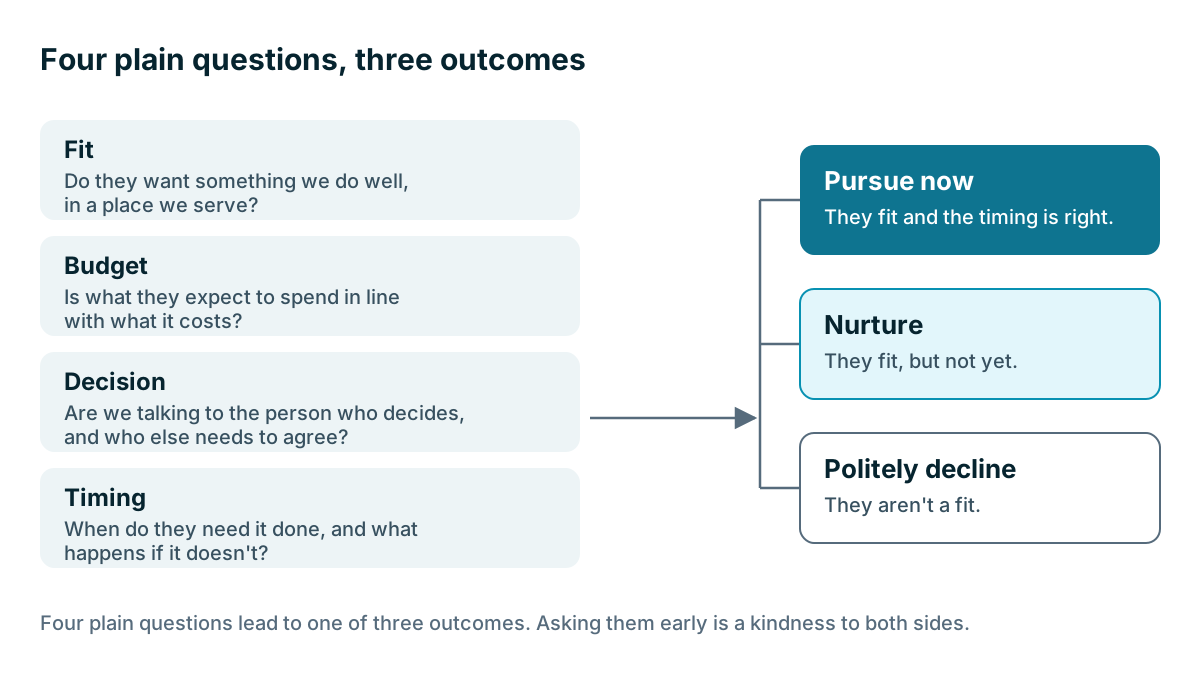
Qualifying means asking a few questions early on, to see whether a lead is a real fit. You'll find plenty of formal methods with acronyms. For a small business, four plain questions cover most of it.
- Fit: do they want something we do well, in a place we serve?
- Budget: is what they expect to spend in line with what it costs?
- Decision: are we talking to the person who decides, and who else needs to agree?
- Timing: when do they need it done, and what happens if it doesn't?
These aren't a form to read out. They are things to find out in a normal conversation.
Going back to the food truck, a wedding enquiry comes in through the website. On a short call, the owner learns:
- Fit: 90 guests, and she can serve up to 120. Yes.
- Budget: they were hoping to spend about half her usual minimum. No, or at least not yet.
- Decision: the couple decide together, and both are on the call. Yes.
- Timing: eight months away, and she is free that day. Yes.
Instead of writing a full quote, she tells them her typical price range for that size of event. They can adjust the menu or the guest count, or they can say thank you and move on. Both outcomes are good ones. She has spent ten minutes rather than two hours.

What are the three outcomes for a lead?
Each lead should leave qualifying with a clear result.
- Pursue now. They fit and the timing is right. Create the deal and book the next step.
- Nurture. They fit, but not yet. Set a dated task to get back in touch, and leave the pipeline clear.
- Politely decline. They aren't a fit. Tell them quickly, perhaps suggest someone else, and mark the lead with a reason.
Saying no quickly isn't rude. It's the best thing you can do for someone who would otherwise wait a week for a quote they can't afford.
Tip
Mention a rough price early. Most owners hold it back out of fear of scaring people off. Those people would have left anyway, after you had done the work. Something like, most jobs like yours land between X and Y, does that fit what you had in mind? is honest, and it saves everyone time.
Record the outcome as well as the call. A lead you declined should carry a reason, such as Outside our area or Below our minimum. After a few months, that list tells you what your marketing is attracting. If half your declined leads are Outside our area, your website may not say clearly where you work.
Don't let your filter go stale
Qualifying rules can quietly shut out good business. A contractor who never takes small jobs might miss the small job that turns into a big customer. Go back to your wins every few months. Do your assumptions still hold? Have some customers you'd have turned away gone on to become your best ones?
And keep the bar simple. In a business with few leads, the best filter may be only one or two questions. A scoring model with points for each answer is usually overkill until you have far more leads than you can call. If your CRM offers lead scoring, it can wait until you are running out of hours.
Speed matters as well. When someone contacts two or three businesses, the one that replies first has an advantage, simply because the customer is still thinking about it. The next lesson covers how to keep that promise once you've made it.
Key takeaways
- Record a lead source for every enquiry, from a short dropdown, at the first contact.
- Judge sources by wins and revenue, not by the number of leads.
- Qualify on four plain questions: fit, budget, decision and timing.
- Every lead ends in one of three places: pursue now, nurture or politely decline.
- Give a rough price early, and recheck your rules against your wins every few months.
Common questions
How do I tell which lead sources bring in the most money?
Count leads, wins and revenue for each source over about six months. Judge each source by its wins and revenue, not by how many leads it sends.
What should I ask a new lead to see if they are a good fit?
Ask about fit, budget, decision and timing. Find these out in a normal conversation rather than reading from a form.
Is it rude to turn down a lead?
No. Saying no quickly can save someone a week of waiting for a quote they cannot afford. Tell them quickly and mark the lead with a reason.
Keep your place and test yourself
Enroll for free to save your progress, take the chapter quiz, and get a certificate when you pass every chapter. The lessons stay open to everyone either way.