

Chapter 4: Pipelines and Sales Funnels
Follow-Up That Doesn't Slip
One rule fixes most dropped follow-up: every open deal has a next step, a date and an owner. Here is how to build that habit, and a simple rhythm for quiet quotes.
Lesson 4 of 6 · 6 min read ·
Many small businesses lose more deals to silence than to competitors. A quote goes out, the customer gets busy, the owner gets busy, and three weeks later nobody can remember whose turn it was to call.
If you have a list of quotes that went quiet, you are looking at the cheapest sales you will ever make. These people have already found you, talked to you and asked for a price. Getting back to them costs nothing but a few minutes.
The one rule
Every open deal has a next step, with a date and an owner.
That's the whole system. If a deal has no next step, it isn't being worked on. Either give it one or close it.
A next step has to be specific enough that anyone on your team could do it.
| Vague | Specific |
|---|---|
| Follow up | Call Ana on Thursday to ask if the HOA has approved the quote |
| Check in | Email Tom on the 14th with the revised start date |
| Waiting on them | If nothing by Friday, text Priya to ask about the deposit |
Waiting on them is the trap. It feels as if the ball is in their court, so it's nothing to do with you. But customers get distracted, and most won't mind a nudge. In every case, write down when you will stop waiting.
Most CRMs have a view that lists deals with no future task, or at least you can build one with a filter. Find it, and look at it each week. That list is where money leaks out.
What rhythm should you follow for quiet quotes?
Deciding in advance what you will do after a quote goes out keeps follow-up on track. Then nobody has to work it out each time, and busy weeks don't change the plan.
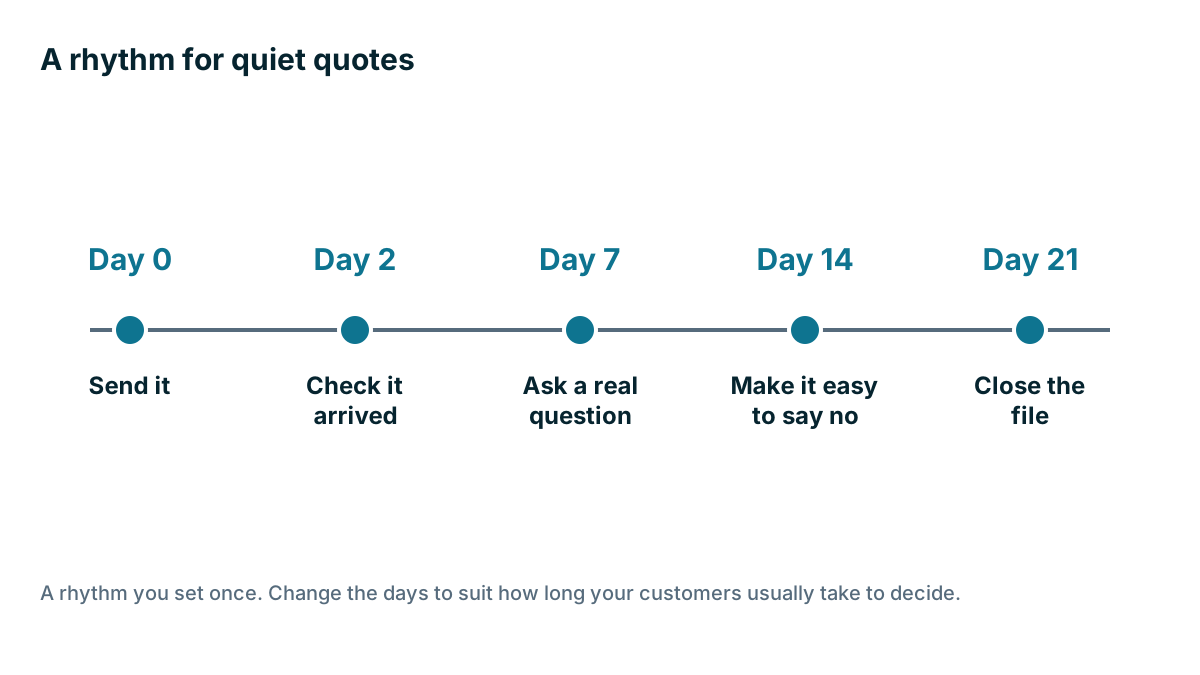
Here is an invented example from a chimney sweep company that quotes for liner replacements. Treat the timing as a starting point, and adjust it to your own sales cycle. A wedding florist might stretch this over months, and a locksmith might fit it into a day.
- Day 0: Send it. Send the quote and say when you will be in touch.
- Day 2: Check it arrived. A short message to make sure they have it and can open it.
- Day 7: Ask a real question. Call, if you can. Is there anything in the quote they'd like to change?
- Day 14: Make it easy to say no. Ask if the job is still on, and say that either answer is fine.
- Day 21: Close the file. Mark it Lost, with a reason, and set a reminder for later in the year.
The Day 14 message often gets a reply, because it takes the pressure off. Something like this works: I don't want to pester you, so I'll close this quote for now. If you'd still like to go ahead, or the timing has changed, just let me know.
Add something each time
Nobody likes getting a message that says, just checking in. It asks them to do work and gives them nothing. Each time you get in touch, try to bring something: an answer to a question they had, a photo of a similar job, a note about lead times, or a smaller option if the price was a stretch.
If you have nothing new to say, ask a straightforward question instead. Are you comparing a few quotes, or is it the timing that's the holdup? People tend to answer those.
How can the CRM do the remembering for you?
Remembering follow-ups is where a CRM earns its keep. You want the reminders to appear by themselves.
- When a quote is sent, a task is created to check in two days later.
- Every morning, each person sees a list of what's due.
- Overdue tasks are visible, not buried.
- When a deal goes untouched for a set number of days, someone gets told.
- When someone is on holiday, you can reassign their tasks in one go.
Start with reminders, not automatic emails. There's a temptation to automate the whole sequence, so messages go out by themselves. For a high-volume business with small deals, that can make sense. For a business where each customer matters, an automatic email sent to someone who called you yesterday looks careless. Let the software tell you when to act, and you do the talking. If you do automate, make sure the sequence stops as soon as the customer replies.
You can get a long way without any automation. A spreadsheet with a Next step date column, sorted each morning, follows the same rule. What matters is the rule, not the tool.
What should the Monday review check?
Give the Monday review fifteen minutes each week. For a small team, do it together at a set time, with the pipeline on the screen. Go through this list in order:
- Deals with no next step. Give each one a step, or close it.
- Overdue tasks. Do them, move them or drop them.
- Deals over their time limit for a stage. What is going on with each one?
- Quotes sent last week. Has each one been checked?
- Deals due to close this month. Is anything in the way?
Keep the meeting about the deals, not about who forgot what. If people feel told off, they will stop recording what's happening, and you will lose the thing you need most.
Watch out
Follow-up has limits. If someone asks you to stop contacting them, stop and record it. Rules on sales emails, calls and texts also differ by country and state, especially for people who haven't bought from you. A quote someone asked for is one thing. A cold list is quite another. Check what applies to you before you set up anything automatic.
What should happen to tasks when the owner is away?
Follow-up usually breaks when one person is sick, on holiday or simply slammed. In a two-person business, that's a weekly risk. Agree who covers for whom, and make the tasks visible to both of you. Before anyone goes away, spend ten minutes moving their open tasks to a named person. If the next step is written clearly, the stand-in can make the call without a handover.
Can you keep following up after the sale?
The rule of a next step, a date and an owner also works for customers you already have. Roofers, chimney sweeps, fire safety firms and many others have a natural reason to get back in touch: a service due, a seasonal check, an anniversary of the job. Create the task when the job closes, dated for when the customer will next need you. In many trades, that's where the easiest next sale comes from.
Key takeaways
- Every open deal needs a next step, a date and an owner. If it has none, give it one or close it.
- Write next steps so that anyone could do them, and put a date on Waiting.
- Set a rhythm for quotes in advance, and adjust the days to your own sales cycle.
- Let the software remind you, and be careful about automatic messages.
- Review deals with no next step for fifteen minutes every week.
Common questions
How do I stop deals going quiet after I send a quote?
Decide in advance what you will do after the quote goes out, then set a dated check-in for each step. Treat the timing as a starting point and adjust it to your own sales cycle.
What makes a next step specific enough?
Anyone on your team should be able to do it. Write who to contact, what to ask or send, and the date. Vague notes such as Follow up are hard to act on.
Should I automate follow-up emails?
Start with reminders rather than automatic emails. For high-volume businesses with small deals, automation can make sense, but make sure the sequence stops as soon as the customer replies.
Keep your place and test yourself
Enroll for free to save your progress, take the chapter quiz, and get a certificate when you pass every chapter. The lessons stay open to everyone either way.