

Chapter 4: Pipelines and Sales Funnels
Funnel Versus Pipeline
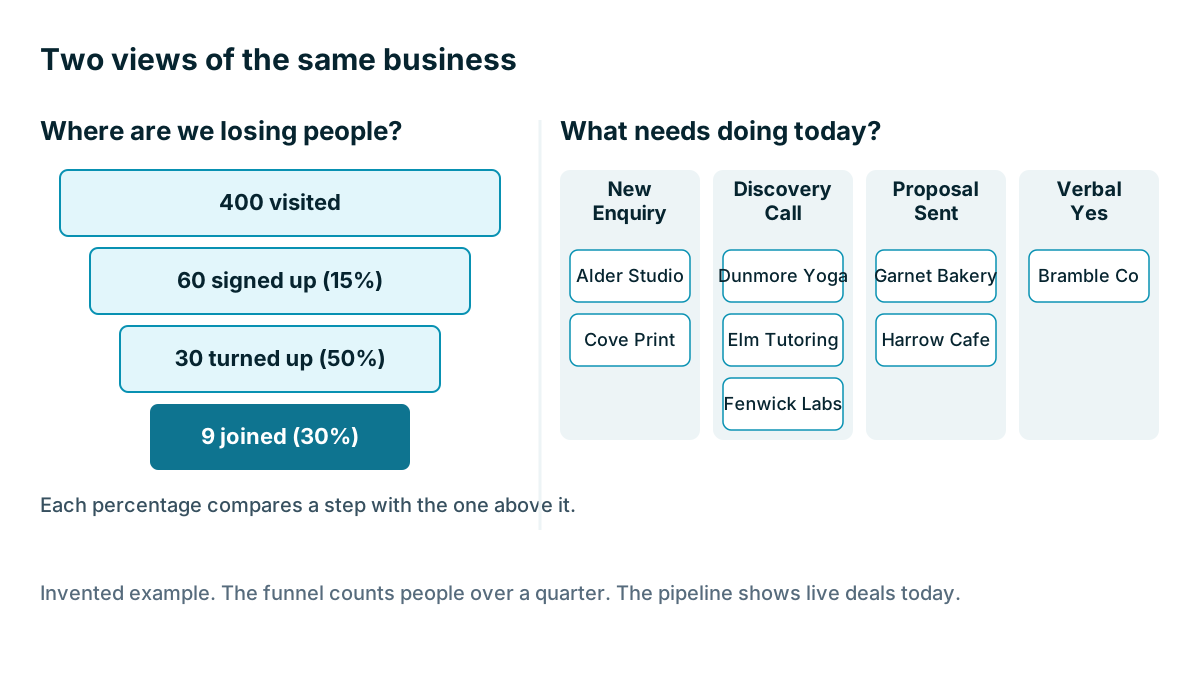
People use these words as if they mean the same thing. They don't. A funnel tells you where you lose people over time, and a pipeline tells you what to do today.
Lesson 1 of 6 · 6 min read ·
Sales funnel and sales pipeline get used as if they mean the same thing, and plenty of software adds to the muddle. The difference is worth a few minutes, because each one answers a different question. If you ask the wrong one, you will fix the wrong thing.
A funnel is about groups of people over a period. It counts how many people reached each step and shows you where they dropped off. It answers the question, where are we losing people?
A pipeline is about individual deals right now. It lists the live deals, where each one stands, and who owns it. It answers the question, what needs doing today?
Think of a funnel as a look back at the last few months, and a pipeline as a photograph of this morning. They use much of the same information, viewed from two directions.
| Funnel | Pipeline | |
|---|---|---|
| Unit | Groups of people | One deal at a time |
| Time | A past period, such as a quarter | Right now |
| Main question | Where are we losing people? | What needs doing today? |
| Who uses it | The owner, every month or quarter | Everyone, every day |
| What you get | A percentage at each step | A list of next actions |
How does a funnel show where people drop off?
Here is an invented example. A yoga studio wants more members, so the owner adds up last quarter's numbers.
- 400 people visited the page offering a free first class.
- 60 signed up for that class. That's 15%.
- 30 turned up. That's 50% of those who signed up.
- 9 became members. That's 30% of those who came.
The instinct would be to spend more on advertising, because 9 feels low and ads bring more visitors. The funnel suggests something else. Half the people who signed up never came. Those 30 no-shows had already said they wanted to try it.
If the studio sent a friendly reminder and got 40 of the 60 to turn up, and the same 30% joined, it would have 12 members instead of 9. That's a third more members, with no extra spending on ads. Fixing a leak near the bottom is often cheaper than pouring more in at the top.
How to find your own leak
You can build a funnel with a pencil. No software is required.
- Write your main steps in order, from first contact to paid. Use four or five.
- Pick a period long enough to give you real numbers, such as the last three or six months.
- Count how many people reached each step.
- Divide each number by the one above it.
- Look for the step with the steepest drop, or the one you think you could improve most easily.
Be careful with small numbers. If only ten people reached a step, one person changes the percentage by ten points. A low-volume business should look at a longer period, and treat the result as a clue rather than a fact. You'll also need to count the people who came in during the same period. If your sales take three months, this month's enquiries haven't had time to turn into sales.
How does a pipeline show what to do today?
Here is another invented example. A two-person agency has eight live proposals. On Monday morning, one partner opens the pipeline board and sees this:
- Two deals are in Proposal Sent, with no contact for ten days.
- One deal is in Verbal Yes, but no contract has gone out.
- Three deals are in Discovery Call, each with a meeting this week.
- Two deals are in New Enquiry, and one of them came in on Friday afternoon.
A funnel would tell them nothing about this morning. The pipeline hands them a to-do list: chase two proposals, send one contract, and answer Friday's enquiry before lunch.
They could spot the same pattern another way. Over the last six months, most of their lost deals went quiet after Proposal Sent. That's a funnel finding, and it might lead them to a better habit, such as walking clients through the proposal on a call rather than emailing it.
That's how the two work together. The pipeline runs the week. The funnel improves the process.

Once you have found a leak, work on one at a time. If you change the reminder, the class times and the price all in one month, you won't know which change helped. Pick a single step, change one thing, and count again next quarter.
How do funnels and pipelines show up in a CRM?
A CRM usually gives you the pipeline first, as a board with a card for each deal and a column for each stage. If you record the date a deal enters each stage, many tools can also produce a funnel report, sometimes called a conversion report, though you may need a higher plan.
There is one catch. A funnel report is only as honest as your stage data. If people drag deals straight from New to Won, the steps between show nothing. If they delete lost deals rather than marking them lost, every percentage looks better than it is.
Watch out
Never delete a lost deal. Mark it Lost and record the reason. A pipeline with its failures removed gives you a funnel that tells you everything is fine, and you will make decisions based on that.
Where the top of the funnel fits
A funnel usually starts earlier than a pipeline. Website visitors, people who follow you, and readers of your newsletter are in your funnel in a loose sense. They don't belong on a pipeline, because there's no deal yet. A deal starts when a real person shows real interest in buying something from you. Otherwise your board fills up with cards that nobody will ever act on. The next lessons cover where that line falls, and how to tell a good lead from a weak one.
If your sales are few and you know each one, you may not need a funnel report at all. A quick count on a sheet of paper once a quarter does the same job.
Key takeaways
- A funnel counts groups of people over a past period and shows where they drop off.
- A pipeline shows individual live deals right now and tells you what to do today.
- Fixing a leak low in the funnel is often cheaper than buying more leads.
- Use longer periods when your numbers are small, and treat small samples as clues.
- Mark lost deals as Lost, with a reason. Deleting them makes your funnel look better than it is.
Common questions
What is the difference between a sales funnel and a sales pipeline?
A funnel counts groups of people over a past period to show where they drop off. A pipeline lists individual live deals right now and shows what to do today.
Where should I look for a leak in my sales process?
Look for the step with the steepest drop, or the one you think you could improve most easily. If your numbers are small, use a longer period and treat the result as a clue.
Should I delete lost deals from my CRM?
No. Mark each deal as Lost and record the reason. Deleting lost deals makes your funnel look better than it is.
Keep your place and test yourself
Enroll for free to save your progress, take the chapter quiz, and get a certificate when you pass every chapter. The lessons stay open to everyone either way.