

Chapter 10: Getting Your Team to Use It
Why People Avoid a CRM
People rarely skip a CRM out of laziness. They skip it because it costs them time and gives them little back. Find the real reason and you can fix it.
Lesson 1 of 6 · 6 min read ·
You bought a CRM, set it up, and told everyone to use it. Three weeks later, half the deals are in it and the other half are in people's heads. This is the most common way a CRM fails, and it usually has little to do with the software.
The easy reaction is to blame the team. That is rarely fair. Someone who avoids a CRM is usually making a sensible choice, based on what it costs them and what they get back. If logging a site visit takes four minutes and nobody ever reads it, skipping it is the rational thing to do. This chapter is about changing that trade.
What trade does each person make when they log a call?
Every time someone finishes a call, they make a small decision: log it, or move on to the next thing. Look at what each side of that decision offers them.
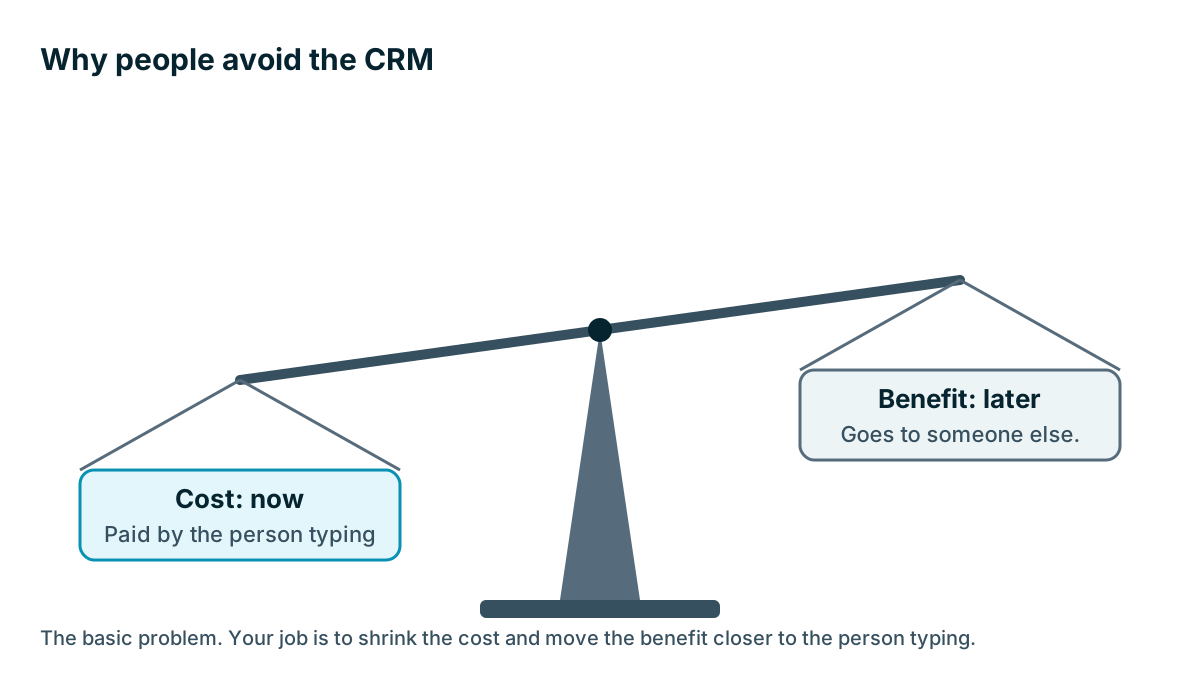
The cost comes now, and the person typing pays it. The benefit comes later, and it often goes to someone else. The owner gets a report. The next salesperson gets the history. The person who did the typing gets a slightly later lunch.
Until you fix that imbalance, reminders and rules will only get you so far. You have two levers. You can make the cost smaller, with fewer fields and fewer clicks. You can also make the benefit bigger and closer, so the person typing gets something useful back the same day.
What are the six reasons people avoid a CRM, and what can you try?
What people say out loud is not always the real reason. Six patterns come up most often.
| What you see or hear | What is often going on | What to try |
|---|---|---|
| It is slower than my old way | Too many fields and clicks | Cut the required fields to the bare minimum |
| What's in it for me? | The CRM serves the boss, not the user | Give them something they use daily, such as their call list |
| They stay vague in their notes | Fear that the numbers will be used against them | Say how the data will be used, and stick to it |
| They keep customers to themselves | Fear of being replaceable | Say plainly why shared records matter and who owns the relationship |
| They ask the same questions each week | Trained once, on too much, too early | Teach one small job at a time |
| They say nobody else uses it | The old system is still running | Retire the old system on a set date |
The last row matters more than it looks. While the old spreadsheet stays open, the CRM is optional, and optional things lose to habit.
How do you find out which reason applies to you?
Don't guess at each person's reason, and don't send a survey. Sit beside each person for 20 minutes while they do their normal work. Ask them to log a real call or a real visit while you watch. Stay quiet and take notes. Then ask three questions:
- What did that make you do that felt pointless?
- What do you need to know before a call that is hard to find?
- What do you still keep somewhere else, and why?
The third question tends to be the best one. If someone keeps a private notebook, that notebook is telling you what the CRM fails to do for them.
Example
An invented example. A moving company has 11 staff, including two estimators who visit homes before a move. The owner complains that estimators log almost nothing, so she rides along on three visits.
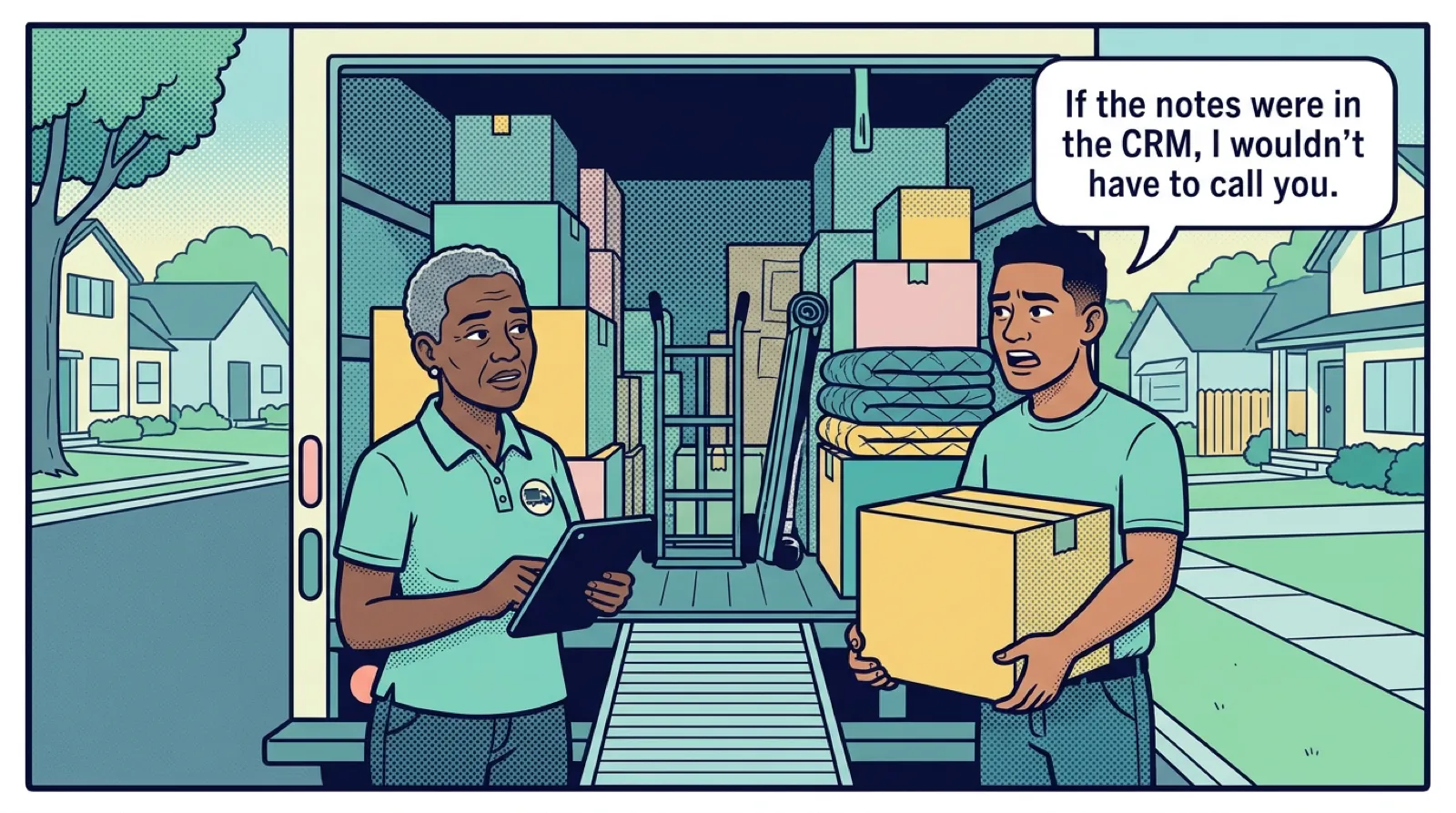
She finds the visit form has 19 fields, and most of them are for the office. She also notices that after each visit, an estimator takes several calls from the crew, asking about stairs, parking and the piano.
So she makes two changes. The form drops to six fields. And the crew's job sheet is now filled from those six fields, so the crew stops calling. The estimator's reward for logging a visit is a quieter afternoon. Logging goes up, with no new rule at all.
Notice what she didn't do. She didn't send a stern email, and she didn't add a league table. She made the entry shorter and made sure the person typing got something back.
Fears are worth naming
Two of the reasons in the table are about fear, and nobody will raise them in a team meeting.
A salesperson at an invented IT services firm has spent six years building relationships. Her customer knowledge is part of why she is valuable. Asking her to put it all in a shared system can feel like asking her to train her replacement. Pretending that worry is silly won't help. Tell her what the shared record is for: so a customer gets a good answer when she is on vacation, and so her pipeline is credited to her. Then behave that way.
The other fear is being watched. A CRM can show who made how many calls, and some people will assume it's there to catch them out. Decide what you will and won't use the data for, and tell people before they ask. If you say the numbers are for coaching, a single public telling-off over a low call count will undo that promise.
What doesn't work on its own
Mandates alone. Telling people that a deal doesn't exist unless it's in the CRM can work, but only after you've fixed the form and retired the old system. Before that, you get thin records entered at 5 pm on Friday to keep the boss quiet.
Prizes for logging. You get lots of logging. It may not be useful logging. Reward the behavior you want, which is deals with clear next steps, and not the raw count of notes.
More features. A person who won't log a call won't be won over by a new dashboard.
Watch out
Some people will still refuse after you've done everything right. By then you are dealing with a performance question, and the answer lives in a private conversation. As Chapter 1 said, software can't fix a team that won't record things. Don't let one holdout set the standard for everyone else.
It's also fair to ask whether the CRM is the right fit at all. If everyone avoids it and the form is already short, go back to your process page from Chapter 2. The tool may not match how you sell.
The rest of this chapter works through the fixes: a short set of rules, training in small steps, managers who model the habit, a setup that suits field staff, and a routine that keeps it all going.
Key takeaways
- People avoid a CRM because the cost comes now and the benefit comes later, often to someone else.
- Shrink the cost with fewer fields, and move the benefit closer to the person typing.
- Find the real reason by sitting with each person, not by guessing or sending a survey.
- Name the fears: being replaceable and being watched. Say how you will use the data, then keep your word.
- While the old system stays open, the CRM is optional. Retire the old system on a set date.
Common questions
Why do team members avoid using a CRM?
Usually the cost falls on the person typing, now, while the benefit comes later and often goes to someone else. Blaming the team is rarely fair, so sit with each person to find the real reason.
How do I stop people skipping CRM entries?
Make the entry shorter, and make sure the person typing gets something useful back the same day. Retire the old system on a set date, because the CRM stays optional while the old one stays open.
Is a mandate enough to get people using a CRM?
Not on its own. A mandate can work, but only after you have fixed the form and retired the old system. Before that, you get thin records entered at 5 pm on Friday.
Keep your place and test yourself
Enroll for free to save your progress, take the chapter quiz, and get a certificate when you pass every chapter. The lessons stay open to everyone either way.