

Chapter 9: Reports That Matter
Sales Cycle and Speed
How long deals take tells you when money will arrive and where work is stuck. Here is how to measure it properly, and why the average can mislead you.
Lesson 3 of 6 · 6 min read ·
Speed matters in sales for two plain reasons. A faster deal brings the money in sooner. And a deal that goes quiet often ends up lost, because the customer's attention moved on. This lesson shows you how to measure speed and how to find the slow part.
What is the sales cycle?
The sales cycle is the number of days from a deal being created to it being won. Your CRM can work this out if it holds both dates, and you can do it in a spreadsheet with two columns.
Knowing your cycle helps with three things. It tells you when today's leads will turn into money. It tells you how long to wait before you worry about a deal. And it gives you something to improve.
Should you track the average or the median?
Here is an invented electrical contractor with eight won deals. The numbers are made up. These are the days each one took:
7, 9, 10, 12, 14, 15, 18, 75
Add them up and you get 160. Divide by 8 and the average is 20 days.
Now look at the list. Only one deal took longer than 20 days. That one deal, the 75-day job, pulled the average up. The median is the middle of the list. With eight numbers, the middle sits between the fourth and fifth, so it's halfway between 12 and 14, which is 13 days.
| Measure | Result | What it tells you |
|---|---|---|
| Average | 20 days | Pulled up by one slow deal |
| Median | 13 days | What a typical deal takes |
| Longest | 75 days | Worth a look by itself |
If your CRM only gives you an average, keep the slowest deals in mind. If you tell a customer that things usually take 20 days, you are off by a week for most jobs. And it's worth asking what made that 75-day deal so slow. It might be a kind of work you should price or manage differently.
Measure won deals only for this figure. Lost deals often drag on for a long time, and they make a different point, which we'll come to.
Time in each stage
The cycle tells you how long the whole trip takes. Stage time tells you where the trip is slow. For the same contractor, the average days in each stage look like this.
| Stage | Who is holding it | Average days |
|---|---|---|
| Enquiry to site visit | Us | 4 |
| Site visit to quote sent | Us | 9 |
| Quote sent to decision | Customer | 7 |
| Whole cycle | 20 |
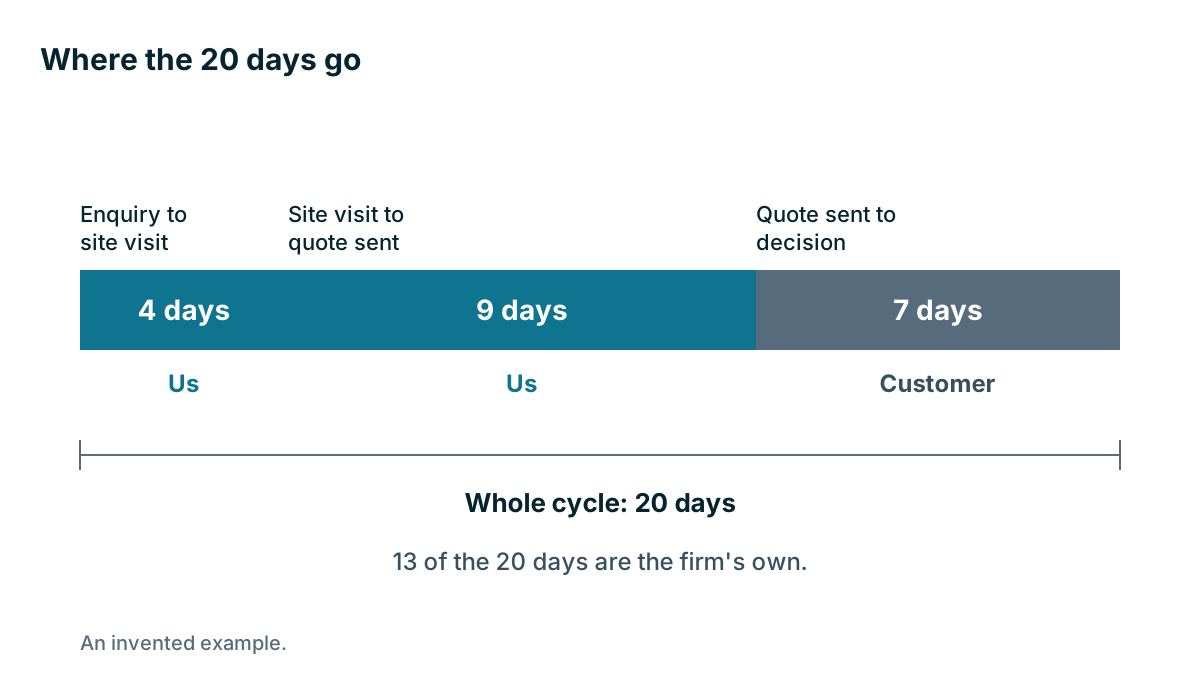
It's easy to assume that customers are the slow part. In this example, 13 of the 20 days are the firm's own. Nine days to write a quote after visiting a site is a long time for a customer to wait, and it's a stretch that a template and a product list from Chapter 6 might cut in half.
Cut those 9 days to 4, and the cycle drops by 5 days, to 15. Notice what that doesn't need: no extra leads, no new tools, no change in price.
Speed to first response
One stage deserves its own number: how long it takes you to answer a new enquiry. You'll have seen claims about how many minutes it should take. We won't quote one, because we can't vouch for those figures and they don't always apply to your trade. Common sense goes a long way. When someone with a burst pipe or a broken shop sign calls three firms, the first one to answer has a head start.
Set a target that fits your work. It might be within one working hour for urgent trades, or the same day for planned work. Then measure it. Your CRM needs two timestamps: when the enquiry arrived and when someone first replied.
Who answers matters too. If the owner is on a roof all morning, the enquiry waits. A shared inbox, a named backup or a short automatic reply saying when you'll call can all help. An automatic reply doesn't count as a response, though. The clock stops when a person has spoken to the customer.

Which open deals are too old?
The most useful speed report isn't about the past. It lists open deals sorted by age. Take your typical cycle and flag anything that has gone well past it. For the contractor, with a median of 13 days, a sensible flag is 26 days, which is twice the typical cycle.
Why does this matter? Old deals often aren't real. A quote that has sat for two months past your normal cycle is usually less likely to close than a fresh one. Check that against your own history. Every such deal needs a decision: call them, set a real next step or close it as lost.
There's a useful side effect. Closing dead deals makes your pipeline total honest, and that makes the pipeline sum in the first lesson of this chapter work.
Example
An invented sign shop looks at 30 open quotes and finds 11 past its 45-day flag. The owner phones all 11 in one afternoon. Four are still live, two want changes, and five say they went elsewhere or dropped the project. Five go to Lost with a reason, and six get a next step. The open list falls to 25, and it's now a list she can believe.
Is faster always better?
Faster isn't always better. Some deals should take time. A large customer may have a real approval process, and pushing them will irritate them. A rushed quote with errors costs more than a slow, correct one. What you want is to remove waiting that adds nothing, particularly the waiting that's on your side.
Seasons also matter. A landscaper's spring deals may close in days, and winter deals in weeks. Compare like with like, such as this spring with last spring.
What should you track?
- Median days to won, for the past three months
- Days in each stage, with a note of who's holding it
- Time to first response on new enquiries
- A list of open deals past your flag
Key takeaways
- The sales cycle is days from created to won. Use the median if you can, because one slow deal can distort the average.
- Time in each stage shows the slow part, and it's often on your side.
- Set and measure a target for first response. The clock stops when a person replies.
- Flag open deals well past your normal cycle, and decide what to do with each one.
Common questions
Why use the median sales cycle instead of the average?
One very slow deal can pull the average up, so most deals look slower than they are. The median is the middle deal, so it shows what a typical deal takes.
How do I find the slow part of my sales process?
Measure the days each stage takes and note who is holding the deal at that point. The slowest stretch is often one you control, such as writing a quote.
How fast should I reply to a new enquiry?
Set a target that fits your work, such as within one working hour for urgent trades or the same day for planned work. An automatic reply does not count as a response.
Keep your place and test yourself
Enroll for free to save your progress, take the chapter quiz, and get a certificate when you pass every chapter. The lessons stay open to everyone either way.