

Chapter 9: Reports That Matter
Lead Source and What's Working
Knowing where your best customers come from tells you where to spend. Here is how to capture source reliably and read it without fooling yourself.
Lesson 4 of 6 · 6 min read ·
Most small businesses spend money on marketing, and few can say what it brought in. Lead source is the field that answers that. It's a dull little dropdown, and it can be one of the most valuable fields in your CRM.
Lead source records how a customer first found you. It has one job: when you have to choose where next month's money goes, it should give you evidence.
How do you capture lead source reliably?
Three rules make lead source reliable.
Use a short fixed list. Six to ten choices is plenty. Free text gives you referral, Referral, referred by Bob and a friend, which can't be added up.
Make it required. If it can be left blank, it will be. Set the field so a new deal or lead can't be saved without it, if your CRM lets you.
Ask the customer. A simple question on the first call, such as how did you hear about us, is more reliable than a guess. Web forms can fill in the field by themselves, and it's still worth asking, because someone may click an ad after a friend recommended you.
A usable list might look like this:
- Referral from a customer
- Referral from a partner or trade contact
- Web search, not paid
- Paid ads
- Social media
- Repeat customer
- Sign, van or walk-in
- Event or trade show
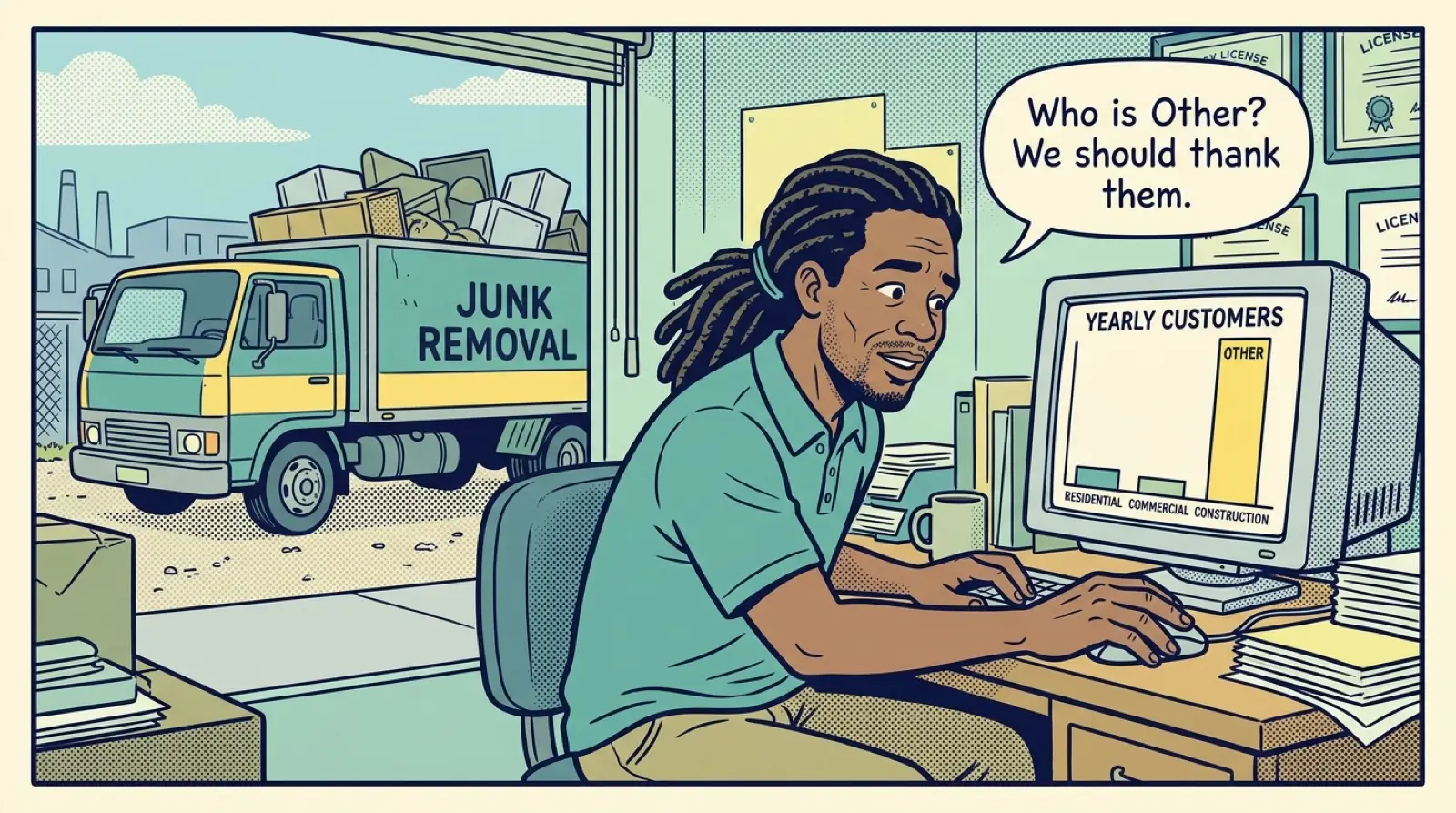
Avoid a choice called Other, or review it every month. Nobody who is in a hurry will pick anything else.
How do you follow a lead source to revenue?
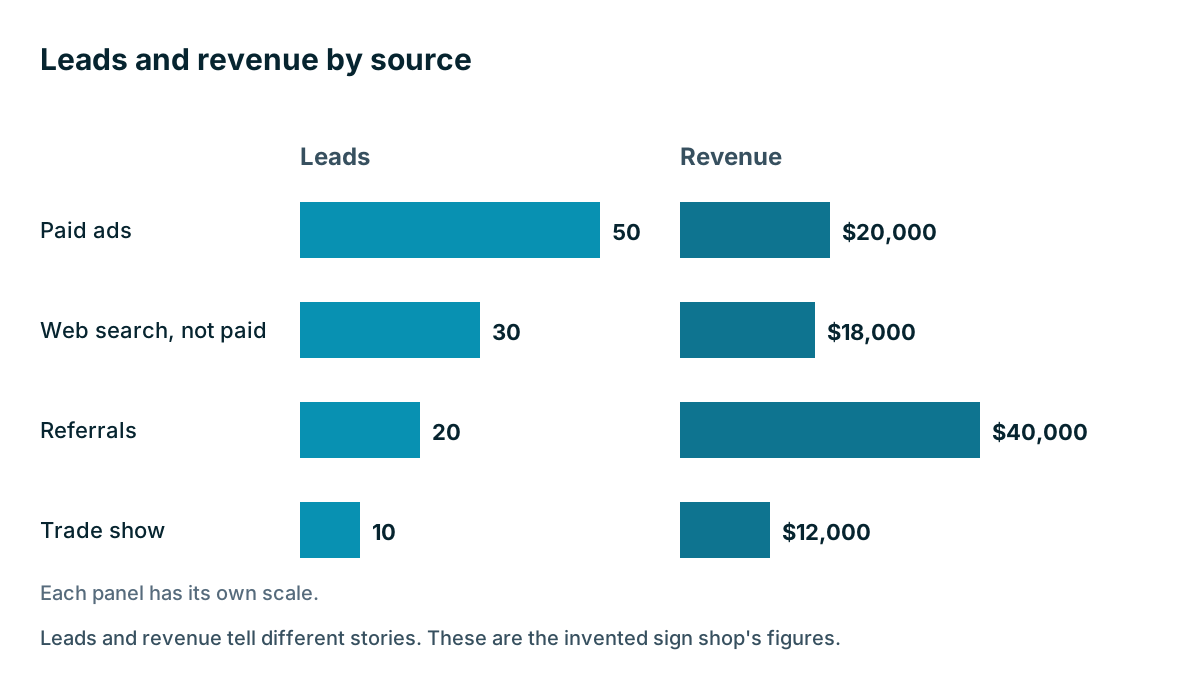
Counting leads per source tells you very little. A source that sends a lot of poor enquiries looks good on that measure, and it's costing you time. Follow each source through to revenue. Here is a year at an invented sign shop. All the numbers are made up.
| Source | Leads | Won | Win rate | Revenue | Spend | Spend per win |
|---|---|---|---|---|---|---|
| Paid ads | 50 | 5 | 10% | $20,000 | $6,000 | $1,200 |
| Web search, not paid | 30 | 6 | 20% | $18,000 | $600 | $100 |
| Referrals | 20 | 8 | 40% | $40,000 | $0 | $0 |
| Trade show | 10 | 1 | 10% | $12,000 | $3,000 | $3,000 |
| Total | 110 | 20 | 18% | $90,000 | $9,600 | $480 |
Now it reads differently. Paid ads bring in the most leads and share the lowest win rate. Referrals bring in 20 leads and nearly half of the revenue. If you looked only at lead counts, you would conclude that ads are the star.
Should you cut the weakest source right away?
The table suggests cutting the trade show and shifting money to referrals. Hold on before you do that.
Small numbers. The trade show has 10 leads and 1 win. One more win could double its revenue. A single year isn't much evidence.
Timing. Trade show contacts may buy next year. If your sales cycle is long, this year's spend may pay off in next year's table.
Referrals aren't free. The spend column says $0, but you pay for them in good work, and you can't pour more money in and get more out in any simple way. You can do more to ask for them, though. A cheap experiment is a follow-up after each finished job. Chapter 6 covered that.
Revenue isn't profit. A $12,000 job with a poor margin may be worth less than a $6,000 job with a good one. If you can add margin per source, do. Also look at your time: 45 of the paid ad leads didn't buy, and each one took some effort.
First touch. The field records the first way someone found you. A customer may have seen your van, been told about you by a neighbor and then found you through a web search. Lead source tells a simple version of a messy story. That's fine for a small business. Software that tries to credit every touch usually needs more volume and more tracking than you have.
So the sensible reading for this sign shop might be: keep the ads, but look at why so few convert. Check the search terms and the landing page. Put an hour a week into asking for referrals. Keep the trade show for one more year, and write down a test for it. That's a business decision backed by numbers, which is the point.
Should repeat customers count as a source?
Be careful about what you count when repeat customers appear as a source. If you have a source called Repeat, keep it apart in your analysis. Repeat business tends to win at a high rate, and including it can make everything look better than it is. A landscaper who renews 40 maintenance contracts doesn't want those drowning out new business.
Fixing the data you already have
You can start today, even with a messy history.
- Agree the list and write down what each choice means
- Make it required on new records
- Fix the old records for the last 12 months as well as you can
- Leave older ones as Unknown instead of guessing
- Check once a month how many new records say Unknown or Other
Your first honest report will come after about a quarter. If you start now, by next year you'll have something worth reading.
Tip
Some sources need a small trick to measure. Use a separate phone number or a simple web address on your van, your ad or your trade show stand. Then you don't have to rely on memory. Keep the setup simple enough that it survives a busy month.
Bring in your spending
The spend column doesn't live in a CRM by default. Get it from your books, by month and by source. Agree what counts: ad spend for sure, and agency fees too. Time on a trade show stand counts, if you're being honest. Compare spend per win with the average value of a won deal to see what you are paying for revenue. For paid ads in the example, $1,200 buys $4,000 of revenue, and for search, $100 buys $3,000.
Spend per win isn't a verdict by itself. Set it against the margin on the work. A $1,200 cost of winning a job with $1,000 of gross profit is a loss, no matter how good the revenue looks.
Key takeaways
- Lead source is a required, short, fixed list, and you should ask the customer.
- Follow each source to won deals and revenue, not only to leads.
- Before you cut anything, check for small numbers, timing, profit and what the source really costs.
- Keep repeat business apart, and keep Other small.
Common questions
What is a lead source field in a CRM?
Lead source records how a customer first found you. Keep it to a short fixed list of six to ten choices, and ask the customer on the first call.
Is counting leads per source enough to judge it?
No. A source that sends many poor enquiries can look good on lead counts while costing you time. Follow each source through to won deals, revenue and spend.
What should I do about an Other option?
Avoid a choice called Other, or review it every month. If Other is your best source, your list needs work.
Keep your place and test yourself
Enroll for free to save your progress, take the chapter quiz, and get a certificate when you pass every chapter. The lessons stay open to everyone either way.