

Chapter 9: Reports That Matter
Conversion Rates and How to Read Them
A conversion rate shows where deals drop out. Here is how to work out each step, find your biggest leak, and avoid being fooled by small numbers.
Lesson 2 of 6 · 7 min read ·
Your overall win rate tells you how many deals you win. It doesn't tell you where you lose the others. For that, you break the journey into steps and look at the conversion rate of each one.
A conversion rate is simple. Of the things that entered a step, what share made it to the next step? Divide the number that came out by the number that went in.
A worked example
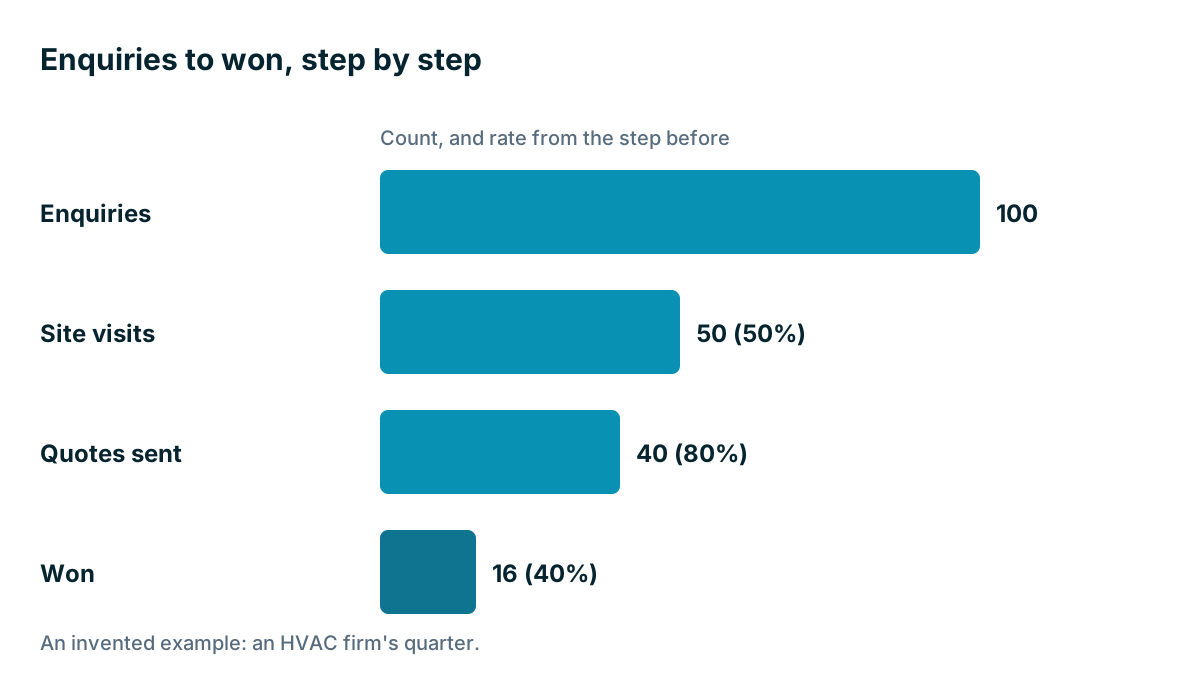
Here is an invented HVAC firm looking at one quarter of replacement work. All the numbers are made up.
| Step | Count | Rate from step before |
|---|---|---|
| Enquiries | 100 | |
| Site visits | 50 | 50% |
| Quotes sent | 40 | 80% |
| Won | 16 | 40% |
Overall, 16 of 100 enquiries became jobs, which is 16%. That single number would tell the owner nothing about what to fix. The step rates do.
Which leak should you fix first?
The instinct is to look at the lowest percentage. Here, that's the 40% at the quote stage. Hold on, though. Ask what happens if you improve each step.
| Improvement | New flow | Wins |
|---|---|---|
| Now | 100, 50, 40, 16 | 16 |
| Site visits up from 50% to 60% | 100, 60, 48, about 19 | About 19 |
| Quote win rate up from 40% to 50% | 100, 50, 40, 20 | 20 |
Both changes help. Now comes the useful part: you need to ask why each step leaks, and what it would cost to fix it.
The 50 enquiries that never got a visit could be poor fits, which would be fine. They could also be calls that nobody returned for three days. A look through 20 of those records will tell you. Each lost deal needs a reason to make this possible, so keep a short required list, such as price, timing, chose competitor, no response and not a fit.
Say that the firm reviews its lost quotes. Most of them have the reason no response. That doesn't point to a price problem. It points to a follow-up problem, and the quote-chasing rule from Chapter 7 is cheap to try.
Tip
Read your lost reasons with some care. Salespeople tend to pick price because it's easy and it isn't their fault. If nearly everything says price, call two or three lost customers and ask what happened. A short, polite call often teaches you more than a year of reports.
What are the three ways to get it wrong?
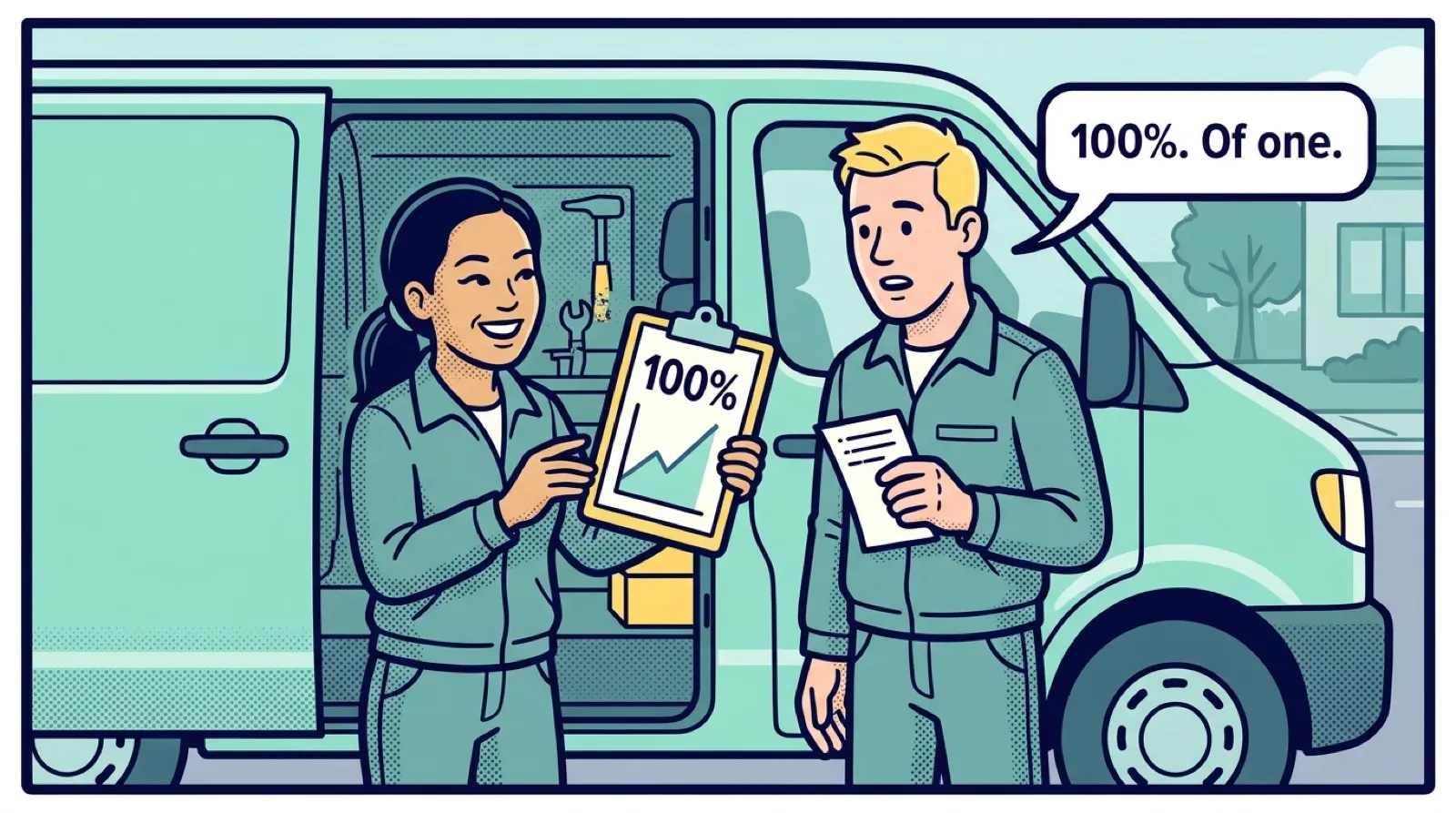
Small numbers. Small numbers are the biggest trap for small firms. If you sent three quotes and won two, your rate is 67%. If you'd won one, it would be 33%. One customer's decision moved the number from 67% to 33%. That isn't a trend. It's three people.
As a rule of thumb, don't read much into a rate with fewer than 20 or so deals behind it. If you don't have that in a month, look at a quarter or a year. You won't always have enough for statistics, and that's fine. Use the numbers to decide what to go and look at, not as proof.
Mixing months. A quote sent in March may be won in May. If you divide May's wins by May's quotes, you are comparing different groups of deals. For a rough monthly view, that's fine. For a fair measure, follow one group. Take every quote sent in March and see how they ended. This group is known as a cohort. Give it time, too, because March's deals may not all have finished by April.
Open deals in the sum. If deals never get marked lost, your numbers get strange. A rate based on all quotes will keep falling as old deals pile up, and a rate based on closed deals will look too good, since nobody ever closed the losers. The cure is to mark deals as lost, honestly and promptly. Lost isn't a failure of the record. It's the most useful data you have.
Should you count deals or add up their value?
You can measure a win rate by counting deals, and you can also measure it by value.
Say an invented sign shop quotes $100,000 of work in a quarter, across 10 quotes. It wins 5 of the 10, for a 50% win rate by count. Those 5 are small jobs adding up to $20,000. By value, its win rate is 20%. The other 5 quotes, worth $80,000, went elsewhere.
That gap tells a story. The shop is winning small jobs and losing large ones. The two rates side by side will show that, and neither would alone. Ask your CRM for both.
| Measure | Sum | Result |
|---|---|---|
| Win rate by count | 5 of 10 quotes | 50% |
| Win rate by value | $20,000 of $100,000 | 20% |
Split it, once you have enough deals
The average hides differences. The useful questions are usually of the form: is it the same for everybody? Compare one split at a time.
- By lead source, which is the subject of a coming lesson
- By type of job, such as repair or replacement
- By salesperson, for coaching and not for blame
- By deal size, as in the sign shop's case
Each split makes the groups smaller, so the small numbers warning comes back quickly. Two or three groups are usually enough.
How do you read a rate in practice?
When you look at any rate, ask these in order:
- How many deals sit behind this number?
- How does it compare with the last few periods?
- Is the definition the same as last time?
- Did something change, such as a price, a person or a season?
- What would we do differently if it's true?
If you have no answer to the last question, the number isn't helping yet.
Key takeaways
- A step conversion rate is what came out divided by what went in. It shows where deals drop out.
- Don't stop at the lowest rate. Work out what improving each step would do, and find out why it leaks.
- Beware of small numbers, mixed months and deals that never get marked lost.
- Look at win rate by count and by value, because the gap between them often tells you something.
Common questions
What is a conversion rate in sales?
It is the share of deals that move from one step to the next. Divide the count that came out of a step by the count that went into it.
Why can a small number of deals mislead me?
One customer's decision can move the rate a lot. Three quotes with two wins is 67%, and one win would make it 33%. As a rule of thumb, be cautious with fewer than about 20 deals behind a rate.
Should I measure win rate by count or by value?
Try both. A rate by count can look fine while the rate by value is poor, and the gap can show that you win small jobs and lose large ones.
Keep your place and test yourself
Enroll for free to save your progress, take the chapter quiz, and get a certificate when you pass every chapter. The lessons stay open to everyone either way.