

Chapter 1: Do You Need a CRM Yet?
What a CRM Is Worth to You: A Simple Sum
A back-of-the-envelope calculation using your own numbers. It takes 20 minutes and tells you whether a CRM is worth paying for, and how much.
Lesson 5 of 5 · 7 min read ·
You won't find your answer in a general return-on-investment figure from a vendor. Their customers are not your business. Your own numbers are better, and you can gather them in about 20 minutes with a calculator and your inbox.
The sum has three parts: what you would gain from fewer lost deals, what you would gain from less time spent hunting for information, and what the whole thing costs. At the end you will have a monthly figure and a simple test.
Step 1: gather your numbers
Use real figures from your last 30 days. If you don't track something, count it by hand from your inbox and phone. Don't guess high.
- Leads per month: how many genuine enquiries you got
- Close rate: of quotes you complete, what share you win
- Average sale: typical value of a job or first-year account
- Gross margin: the share of a sale you keep after direct costs like materials and labor
- Dropped leads per month: enquiries that went quiet because you forgot, were slow, or lost track
- Hours per week: time spent hunting for information, rebuilding lists, or asking who said what
- Value of an hour: what an hour of that person's time is worth to the business
That dropped leads figure matters most. Count it from the check you did in the signs lesson. Don't estimate. If you truly can't find any dropped leads, write zero.
Step 2: value the dropped leads
Use profit, not revenue, because revenue isn't money you keep.
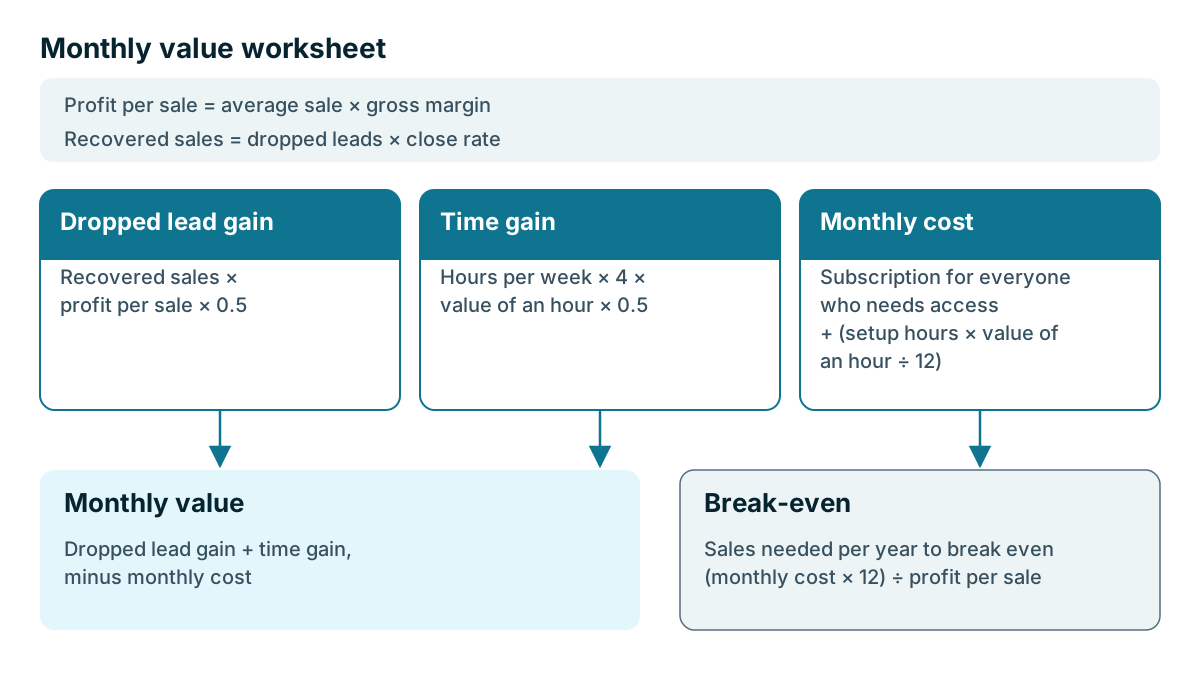
Profit per sale = average sale × gross margin
Recovered sales per month = dropped leads × close rate
Monthly gain = recovered sales × profit per sale × 0.5
The 0.5 at the end is a safety factor. A CRM won't save every dropped lead, and some of those leads may have been weak ones. Halving keeps you honest. It is a judgment call, not a measured figure, so use a smaller number if you want to be stricter.
Step 3: value the time saved
Monthly time gain = hours per week × 4 × value of an hour × 0.5
The same safety factor applies. Saved time only counts if it goes to something useful. If that hour turns into scrolling, count it as zero.
Step 4: add up the cost
Most people use only the subscription price here, and that makes the result look better than it is.
Monthly cost = subscription for everyone who needs access + (setup hours × value of an hour ÷ 12)
Setup time is real. Moving data, learning the tool and building your pipeline can take days. Spreading it over 12 months gives a fair first-year figure. Chapter 2 shows how to work out the true subscription price from a pricing page. For now, use a rough figure from any CRM you are looking at.
Step 5: find your answer
Monthly value = dropped lead gain + time gain, minus monthly cost
Then run the break-even test, which is easier to trust:
Sales needed per year to break even = (monthly cost × 12) ÷ profit per sale
If one extra sale a year pays for it, the decision is easy. If you need ten, it may not be.
What do three worked examples look like?
All three businesses below are invented, and the $40 seat price is a number made up to keep the sums simple. It isn't the price of any real product.
Example
A roofer with three people using the system. 30 leads a month, a 25% close rate, a $9,000 average job and a 30% gross margin. A count of last month turned up 3 dropped leads. About 3 hours a week go on hunting for information, valued at $40 an hour. Setup takes 30 hours.
- Profit per sale: $9,000 × 30% = $2,700
- Dropped lead gain: 3 × 25% × $2,700 × 0.5 = $1,012.50
- Time gain: 3 × 4 × $40 × 0.5 = $240
- Cost: (3 × $40) + (30 × $40 ÷ 12) = $120 + $100 = $220
- Monthly value: about $1,030
- Break-even: ($220 × 12) ÷ $2,700 = about 1 extra job a year
This is an easy yes. One extra roof in a year covers it.
Example
A bakery wholesaler with two people using the system. 8 leads a month, a 50% close rate, $4,000 average first-year sales per account, and a 40% gross margin. They found 1 dropped lead. Two hours a week are lost, valued at $30 an hour. Setup takes 15 hours.
- Profit per sale: $4,000 × 40% = $1,600
- Dropped lead gain: 1 × 50% × $1,600 × 0.5 = $400
- Time gain: 2 × 4 × $30 × 0.5 = $120
- Cost: (2 × $40) + (15 × $30 ÷ 12) = $80 + $37.50 = $117.50
- Monthly value: about $400
- Break-even: ($117.50 × 12) ÷ $1,600 = under 1 extra account a year
Worth doing, though with less urgency. A simple tool would do.
Example
A two-person agency. 4 leads a month, a 33% close rate, $6,000 average projects and a 50% gross margin. They checked carefully and found no dropped leads. One hour a week is lost, valued at $60. Setup takes 10 hours.
- Profit per sale: $6,000 × 50% = $3,000
- Dropped lead gain: 0 dropped leads, so $0
- Time gain: 1 × 4 × $60 × 0.5 = $120
- Cost: (2 × $40) + (10 × $60 ÷ 12) = $80 + $50 = $130
- Monthly value: minus $10
- Break-even: ($130 × 12) ÷ $3,000 = under 1 extra project a year
Close to zero. Their tidy spreadsheet is doing the job, so they should keep it and check again in six months.
| Business | Monthly value | Extra sales a year to break even | Verdict |
|---|---|---|---|
| Roofer | About $1,030 | About 1 | Yes |
| Bakery wholesaler | About $400 | Under 1 | Yes, keep it simple |
| Two-person agency | Minus $10 | Under 1 | Not yet |
What does your result mean?
- Comfortably positive, and break-even at one or two sales a year. Move on to Chapter 2.
- Close to zero. Keep your spreadsheet, fix your Monday routine, and rerun the sum in six months.
- Negative. You don't need a CRM yet. That is a good result, because you just saved the money.
The agency's case also shows a limit of this sum. Break-even looks fine at under one sale, but they have no dropped leads to recover, so the extra sale has no likely source. Always ask where the extra sale would come from.
Watch out
Be suspicious if your sum depends on a big number you guessed. Don't count on a CRM raising your close rate or doubling your leads. This sum only counts things you can already see going wrong.
You now have what you need for the question this chapter started with. You know what a CRM does, whether you show the signs, what it won't fix, and what it is worth in your own numbers. If the answer is not yet, you are finished for now, and you have a good spreadsheet to go with it.
Key takeaways
- Use your own numbers. Count dropped leads from real work instead of estimating.
- Value recovered sales in profit, not revenue, and apply a safety factor to anything you are hoping for.
- Include setup time in the cost. It is easy to leave out, and it is real.
- Check where an extra sale would actually come from before you trust a break-even figure.
Common questions
How do I work out whether a CRM is worth the money?
Use real figures from the last 30 days. Count the leads you dropped, the hours lost to hunting for information, and the monthly cost. Value recovered sales as profit, not revenue.
What is a break-even sale for a CRM?
It is the number of extra sales a year that covers the cost. Multiply the monthly cost by 12, then divide by the profit per sale. If one extra sale a year pays for it, the decision is easy.
Should I count setup time when pricing a CRM?
Yes. Moving data, learning the tool and building your pipeline can take days. Spreading that setup time over 12 months gives a fair first-year figure, rather than looking at the subscription price alone.
Keep your place and test yourself
Enroll for free to save your progress, take the chapter quiz, and get a certificate when you pass every chapter. The lessons stay open to everyone either way.