

Chapter 1: Do You Need a CRM Yet?
When a Spreadsheet Is Still the Right Call
A CRM company telling you not to buy a CRM yet. Here is when a spreadsheet wins, and how to build one that holds up.
Lesson 3 of 5 · 6 min read ·
For many new businesses, a spreadsheet is the correct choice. It is free or close to it, you already know how to use it, and it bends to whatever you need this week. A new business changes how it sells every few months, and a sheet can keep up with that at no cost.
The usual advice from CRM companies is that you should start early so you build good habits. There is some truth in that. There is also an obvious reason they say it. Here is a more balanced view.
When is a spreadsheet enough?
A spreadsheet is likely enough if most of these are true:
- You have few active deals. If you can hold every open deal in your head and list them from memory right now, a sheet is plenty. The right number depends on you, so test it rather than trust a rule.
- One person does the selling. Most CRM value comes from sharing information. When you are the only seller, there is less to share.
- Deals close fast. A bakery that sells by phone in one call has little to track. The long, multi-step sale is what creates the need.
- Customers buy from you repeatedly by habit. A standing order needs an order system more than a sales pipeline.
- You are still working out what you sell. If your offer changes monthly, setting up software around it is wasted work.
Example
An invented example. A two-person brand design agency runs on referrals. They take on about four new projects a year, and each comes from someone they already know. They have a sheet with 40 past clients and a column for last contact date. Once a quarter they sort by that column and send a few friendly emails. It takes 20 minutes. A CRM would cost them money every month and save them almost nothing. They should keep the sheet.
The same holds for many tradespeople in their first year, and for most solo consultants. If that describes you, the most useful thing we can tell you is not to buy any CRM yet, ours included. Coeffection in particular is built for teams with far more going on than this, and a solo owner with a short list of customers would be paying for machinery they don't need.
How do you build a sheet that holds up?
Most spreadsheets fail for lack of a few simple rules. Keep these and yours can last for years.
One sheet, one owner. Keep a single shared file. Name one person who is responsible for keeping it clean. No personal copies.
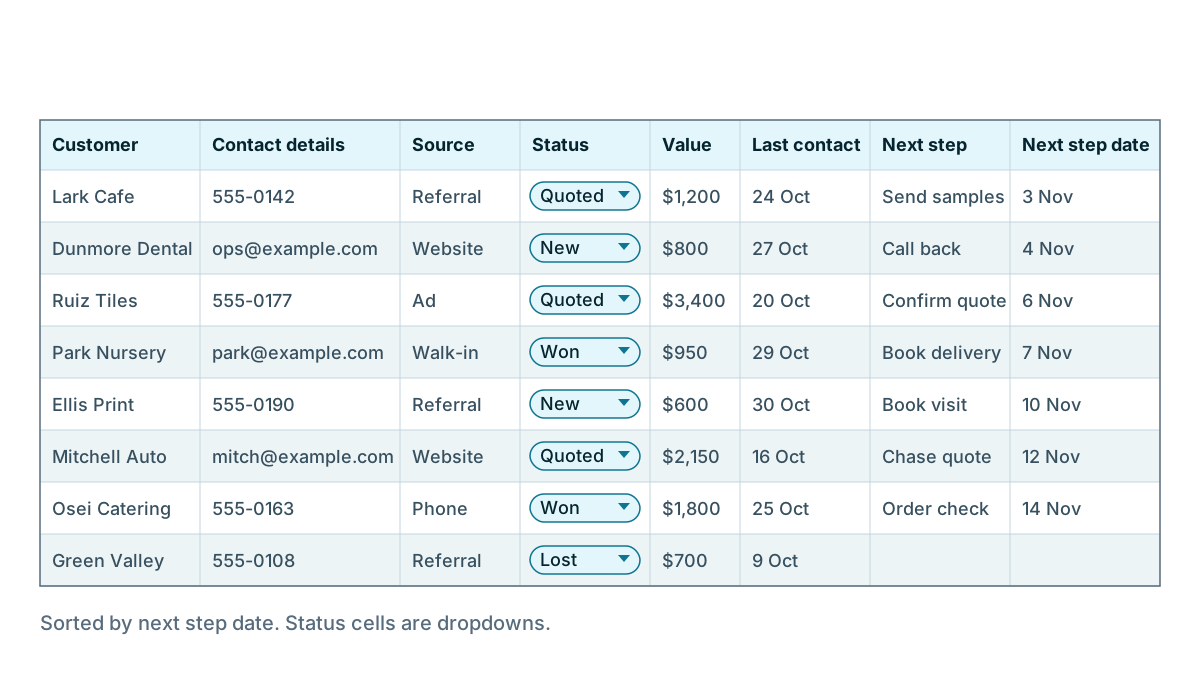
One row per deal. Not one per customer. A returning customer gets a new row for each new deal, so you can see how much they have bought over time.
Use dropdowns for status. A dropdown stops the spread of Open, open, Active and In Progress, which all mean the same thing and ruin any count you try to do. Google Sheets and Excel both let you restrict a cell to a list.
Always fill in Next step and Next step date. These two columns do most of the work. They are the reminder engine a CRM would otherwise give you. Sort by date every morning.
Freeze the top row and turn on filters. Thirty seconds of setup makes the sheet much easier to read and filter.
Here is a starting layout. Add columns only when you have a real question they will answer.
| Column | What goes in it | Why it matters |
|---|---|---|
| Customer | Name of person or company | Who the deal is with |
| Contact details | Phone and email | So you can reach them |
| Source | Referral, website, ad | Tells you what brings in work |
| Status | Dropdown: New, Quoted, Won, Lost | Lets you count and filter |
| Value | Quote amount | Tells you what is at stake |
| Last contact | Date | Shows what has gone stale |
| Next step | One short action | What you will do |
| Next step date | Date | When you will do it |
What weekly habit makes a sheet work?
A sheet has no reminders, so the reminder has to be you. Put 15 minutes on your calendar every Monday:
- Add any new enquiries from the past week
- Update the status of every open deal
- Make sure every open deal has a next step and a date
- Mark as Lost anything that has been silent too long, and note why
- Sort by next step date and put this week's calls on your calendar
This routine is worth doing even if you later buy a CRM, because a CRM needs exactly the same habit. Software can prompt you. It can't make you look.

When to revisit the decision
A spreadsheet stops being enough for one of a few reasons, and they tend to be obvious once you know to look:
- You hire someone else who sells or answers enquiries.
- Your Monday review starts running well past 15 minutes.
- A deal slips through even though you kept the routine.
- You need email history attached to each customer and copying it across is taking real time.
Put a note on your calendar for six months from now to go back through the six signs from the last lesson. That is cheap, and it means you won't drift past the point where a change would have paid off.
Tip
Keep your sheet clean even if you expect to move. Clean rows with consistent columns import into a CRM with little trouble. A messy sheet makes the first week in any new system much harder, and that first week is when people decide whether they like it.
Key takeaways
- A spreadsheet is often the right choice for a solo seller, a low number of deals, short sales, or a business still finding its offer.
- Use one sheet, one owner, one row per deal, dropdowns for status, and a next step with a date on every open deal.
- Fifteen minutes every Monday does most of what a CRM's reminders would do.
- Set a calendar note to recheck the signs in six months, so you don't stay on a sheet past its use.
Common questions
Is a spreadsheet good enough for a solo business?
For most solo consultants, and many tradespeople in their first year, a spreadsheet is often enough. A solo seller has little to share, and most CRM value comes from sharing information.
How do I set up a sales spreadsheet?
Keep one shared file with one owner and one row per deal. Use a dropdown for status, and always fill in the next step and its date.
When should I switch from a spreadsheet to a CRM?
A spreadsheet stops being enough when you hire someone else who sells, when your Monday review runs well past 15 minutes, or when a deal slips through even though you kept the routine.
Keep your place and test yourself
Enroll for free to save your progress, take the chapter quiz, and get a certificate when you pass every chapter. The lessons stay open to everyone either way.