

Chapter 1: Do You Need a CRM Yet?
Signs You've Outgrown Spreadsheets and Your Inbox
The warning signs are specific and you can check them this week. Here are the ones that matter and how to test for each.
Lesson 2 of 5 · 6 min read ·
Nobody wakes up and decides they have outgrown a spreadsheet. It happens gradually. The sheet gets a few more columns, the inbox gets a few more folders, and one day a good customer goes to someone else because you forgot to call them back.
You can spot this before it costs you much. The signs below are things you can check, not feelings. Go through them with your real work in front of you.
Sign 1: are leads going quiet without anyone noticing?
Leads that go quiet are the most expensive sign you have outgrown a spreadsheet, and the hardest to see, because a forgotten lead leaves no trace. Nothing turns red. It just stops.
How to check. List every enquiry from the last 30 days, using your inbox, phone log and web form. Mark each one as won, lost, or still open. Now look at the open ones. For how many can you say what the next step is and when it will happen? Any lead without a next step is a lead you are relying on luck to win.
Sign 2: is your customer information stuck in one person's head?
Customer information is stuck in one person's head when nobody else could pick up the open deals during a week out sick. Could they see what was promised, and to whom?
In a two-person business this feels fine because you sit next to each other. It stops being fine the first time your partner is on holiday and a customer calls asking about a discount you agreed on in a phone call.
How to check. Pick three live deals. Ask someone else on your team to tell you the latest status of each without asking you. If you work alone, try this version: could you hand your business to a helper for a week with less than an hour of explaining?
Sign 3: do two people contact the same customer?
Two people contacting the same customer is how shared inboxes and shared spreadsheets usually break down. Two people reply to the same enquiry, or one person quotes a price while another quotes a different one. Customers notice this quickly, and it makes a small business look disorganized.
How to check. Ask your team whether this has happened in the last three months. If nobody can recall a case, you probably don't have this problem yet.
Sign 4: has your spreadsheet stopped being true?
A spreadsheet stops being true when people get too busy to keep it up, even though every sheet starts out accurate. Someone adds a column called Status 2. Three people keep their own copies. A row says a deal is open when it closed last month.
Once people stop trusting the sheet, they stop updating it, and that makes it less trustworthy still. A CRM can fall into the same trap, as we will see, but a sheet with no owner and no structure gets there much faster.
How to check. Pick ten rows at random and verify them against what really happened. If more than a couple are wrong, you no longer have a record. You have a rough memory.
Sign 5: can you answer simple questions quickly?
If simple questions about your customers take more than a few minutes, or the answer is a guess, your system is holding you back. Try these with a stopwatch:
- How much open quote value do we have right now?
- Which customers haven't we spoken to in six months?
- Where did our last ten customers come from?
If each takes more than a few minutes, or the answer is a guess, you are making decisions without the numbers you could easily have. Each question sounds small. Together they are how you decide what to spend on marketing and who to call on a slow week.
Sign 6: are you retyping the same details?
Retyping the same details is a sign when one customer gets entered in several places: the name goes in the sheet, then the quote, then the invoice, then the job schedule. Every retype costs a few minutes and is a chance to get a phone number wrong.
Example
An invented example. A bakery wholesaler sells to 35 cafes and has one salesperson plus the owner. Their spreadsheet held every account. It worked for two years. Then the owner tried a quick check of Sign 1 and found that of 22 enquiries in the past month, seven had no clear next step. Two of them were cafes that had asked for samples. Nobody had decided to ignore them. The samples just never got onto anyone's list. That is what this problem looks like. It is quiet, and it isn't anyone's fault.
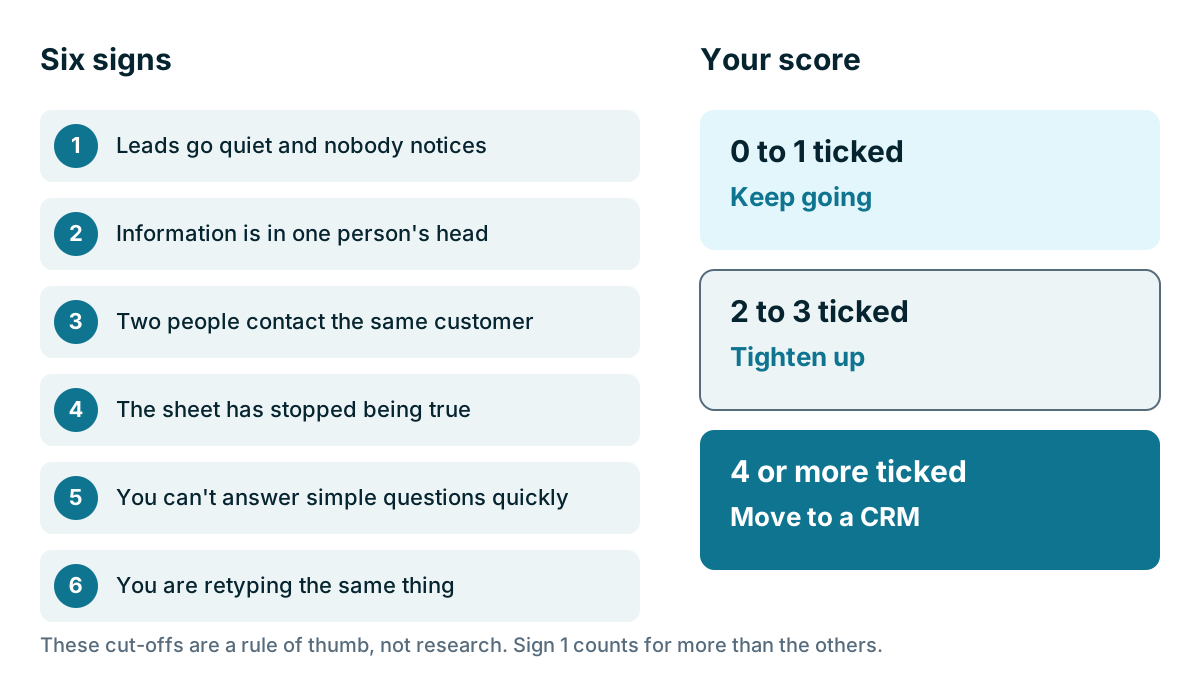
How many signs mean you need a CRM?
Four or more of these six signs means a CRM is likely to pay for itself. Two or three means a better spreadsheet and a weekly habit may be enough.
Be strict. Tick a box only if you checked it against real work this week, not because it sounds familiar.
- More than one or two recent leads have no clear next step
- Someone else could not take over your open deals without a long briefing
- Two people have contacted the same customer without knowing it
- A spot check of ten rows found several that were wrong
- Basic questions about open quotes or lead sources take more than a few minutes
- You regularly type the same customer details into three or more places
How to read your result:
- None or one ticked. Your system is working. Read the next lesson before you spend anything.
- Two or three ticked. You have a real problem, but you may be able to fix it with a better spreadsheet and a weekly habit. Read the next lesson, then run the sum in the last lesson of this chapter.
- Four or more ticked. A CRM is likely to pay for itself. Still run the sum, because it will tell you how much is sensible to spend.
These cut-offs are our rule of thumb, not research. Sign 1 counts for more than the others. One clear case of leads going missing can justify a change on its own, if your deals are large.
Watch out
Growth alone is not a sign. Having more customers does not mean you need a CRM, and neither does hiring your first employee. Plenty of busy businesses run well on a simple system. Watch for the symptoms above, not your headcount.
Key takeaways
- The signs are specific: lost leads, knowledge stuck in one head, duplicate contact, a sheet nobody trusts, slow answers, and repeat typing.
- Check them against real work from the last 30 days, not against your impression of how things are going.
- Lost leads are the most expensive sign and the easiest to miss, because they leave no trace.
- Growth by itself doesn't mean you need a CRM. Symptoms do.
Common questions
What is the biggest sign I have outgrown spreadsheets?
Leads going quiet. It is the most expensive sign and the easiest to miss, because a forgotten lead leaves no trace.
Does growing my team mean I need a CRM?
No. More customers or a first hire does not mean you need one. Plenty of busy businesses run well on a simple system. Watch for the symptoms, not your headcount.
Can a better spreadsheet fix the problem?
Sometimes. With two or three signs, a better spreadsheet and a weekly habit may be enough.
Keep your place and test yourself
Enroll for free to save your progress, take the chapter quiz, and get a certificate when you pass every chapter. The lessons stay open to everyone either way.